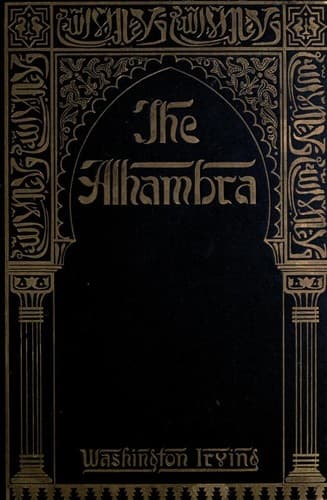
Verhalen over het gebouwencomplex in Granada, dat eigendom was van de laatste islamitische vorsten in Spanje.
While the Moorish cavaliers admired this daring exploit, they felt bound
to resent it. On the following day, therefore, Tarfé, one of the
stoutest among them, paraded in front of the Christian army, dragging
the tablet bearing the sacred inscription AVE MARIA, at his horse’s
tail. The cause of the Virgin was eagerly vindicated by Garcilaso de la
Vega, who slew the Moor in single combat, and elevated the tablet in
devotion and triumph at the end of his lance.
The drama founded on this exploit is prodigiously popular with the
common people. Although it has been acted time out of mind, it never
fails to draw crowds, who become completely lost in the delusions of
the scene. When their favorite Pulgar strides about with many a mouthy
speech, in the very midst of the Moorish capital, he is cheered with
enthusiastic bravos; and when he nails the tablet to the door of the
mosque, the theatre absolutely shakes with the thunders of applause. On
the other hand, the unlucky actors who figure in the part of the Moors,
have to bear the brunt of popular indignation; which at times equals
that of the Hero of Lamanche, at the puppet-show of Gines de Passamonte;
for, when the infidel Tarfé plucks down the tablet to tie it to his
horse’s tail, some of the audience rise in fury, and are ready to jump
upon the stage to revenge this insult to the Virgin.
By the way, the actual lineal descendant of Hernando del Pulgar was the
Marquis de Salar. As the legitimate representative of that madcap hero,
and in commemoration and reward of this hero’s exploit above mentioned,
he inherited the right to enter the cathedral on certain occasions, on
horseback; to sit within the choir, and to put on his hat at the
elevation of the host, though these privileges were often and
obstinately contested by the clergy. I met him occasionally in society;
he was young, of agreeable appearance and manners, with bright black
eyes, in which appeared to lurk some of the fire of his ancestors. Among
the paintings in the Vivarrambla, on the fête of Corpus Christi, were
some depicting, in vivid style, the exploits of the family hero. An old
gray-headed servant of the Pulgars shed tears on beholding them, and
hurried home to inform the marquis. The eager zeal and enthusiasm of the
old domestic only provoked a light laugh from his young master;
whereupon, turning to the brother of the marquis, with that freedom
allowed in Spain to old family servants, “Come, Señor,” cried he, “you
are more considerate than your brother; come and see your ancestor in
all his glory!”
Public-domain text, read in full here on John Shaqi.
Reviews
Reviews
No reviews yet
Be the first to share your thoughts on this work.
Elsewhere in the archive
Join the Discussion
Join the discussion
Sign in to leave a comment or review.
Sign InorCreate an account