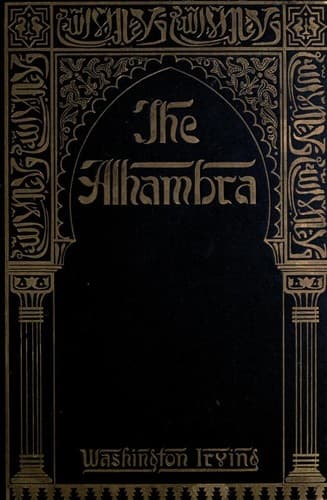
Verhalen over het gebouwencomplex in Granada, dat eigendom was van de laatste islamitische vorsten in Spanje.
As we wended our way back to the Alhambra, Mateo was in high glee and
garrulous vein. “Ah, Señor,” exclaimed he, “there is no place in all the
world like Granada for grand ceremonies (_funciones grandes_); a man
need spend nothing on pleasure here, it is all furnished him gratis.”
Pero, el dia de la Toma! Ah, Señor! el dia de la Toma! “But the day of
the Taking! ah, Señor the day of the Taking!”--that was the great day
which crowned Mateo’s notions of perfect felicity. The Dia de la Toma, I
found, was the anniversary of the capture or taking possession of
Granada by the army of Ferdinand and Isabella.
On that day, according to Mateo, the whole city is abandoned to revelry.
The great alarm-bell on the watch-tower of the Alhambra (_la Torre de la
vela_) sends forth its clanging peals from morn till night; the sound
pervades the whole Vega, and echoes along the mountains, summoning the
peasantry from far and near to the festivities of the metropolis. “Happy
the damsel,” says Mateo, “who can get a chance to ring that bell; it is
a charm to insure a husband within the year.”
Throughout the day the Alhambra is thrown open to the public. Its halls
and courts, where the Moorish monarchs once held sway, resound with the
guitar and castanet, and gay groups, in the fanciful dresses of
Andalusia, perform their traditional dances inherited from the Moors.
A grand procession, emblematic of the taking possession of the city,
moves through the principal streets. The banner of Ferdinand and
Isabella, that precious relic of the Conquest, is brought forth from its
depository, and borne in triumph by the Alferez mayor, or grand
standard-bearer. The portable camp-altar, carried about with the
sovereigns in all their campaigns, is transported into the chapel royal
of the cathedral, and placed before their sepulchre, where their
effigies lie in monumental marble. High mass is then performed in memory
of the Conquest; and at a certain part of the ceremony the Alferez mayor
puts on his hat, and waves the standard above the tomb of the
conquerors.
A more whimsical memorial of the Conquest is exhibited in the evening at
the theatre. A popular drama is performed, entitled AVE MARIA, turning
on a famous achievement of Hernando del Pulgar, surnamed “el de las
Hazañas” (he of the exploits), a madcap warrior, the favorite hero of
the populace of Granada. During the time of the siege, the young Moorish
and Spanish cavaliers vied with each other in extravagant bravadoes. On
one occasion this Hernando del Pulgar, at the head of a handful of
followers, made a dash into Granada in the dead of the night, nailed the
inscription of AVE MARIA with his dagger to the gate of the principal
mosque, a token of having consecrated it to the Virgin, and effected his
retreat in safety.[15]
Public-domain text, read in full here on John Shaqi.
Reviews
Reviews
No reviews yet
Be the first to share your thoughts on this work.
Elsewhere in the archive
Join the Discussion
Join the discussion
Sign in to leave a comment or review.
Sign InorCreate an account