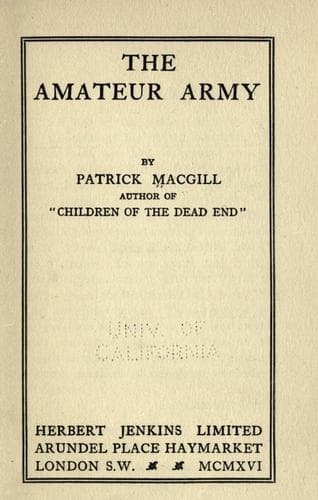
Great Britain. Army -- Military life; World War, 1914-1918 -- Personal narratives, English
Divisional exercise is a great game of make-believe. All sorts of
liberties are taken, the clock is put forward or back at the command
of the general, a great enemy army is created in the twinkling of an
eye, day is turned into night and a regular game of topsy-turvydom
indulged in. On the occasion of which I write the whole division
was out. The time was nine o'clock in the forenoon, and an imaginary
forced march was nearly completed, and an imaginary day was at an end.
We were being hurried up as reinforcements to the main army, which was
in touch with the enemy ahead and an engagement was developing. Our
battalion came to a halt on the roadway, closing in to the left in
order to give full play to the field telephone service in process of
being laid.
Our officers went out in front to seek a position for a bivouac; the
doctor accompanied them to examine the place chosen, see to the
water supply, the drainage, and sanitation. In addition to this, our
commanders had to find the battalion a resting-ground easy to defend
and of merit as a tactical position.
At ten o'clock we lay down, battalion after battalion, just as we
halted: equipment on, our packs unloosened but shoved up under our
heads, and our rifles by our sides, muzzles towards the enemy. One
word of command would bring twenty thousand men from their beds, ready
in an instant, rifles loaded, bayonets at hips, quick to the route and
ready for battle. We would rise, as we slept, in full marching order,
and the space of a moment would find us hurrying, fully armed, into
battle, with the sleep of night still heavy in our eyes.
For miles around the soldiers lay down, each in his place and every
place occupied. Hardly a word was spoken; commands were whispered, and
our officers crept round explaining the work ahead. Two miles in front
the enemy was assembled in great strength on a river, and by dawn, if
all went well, we would enter the firing line. At present we had to
lie still; no man was to move about, and sentries with fixed bayonets
were stationed at front, flank, and rear, ready to give the alarm at
the first sign of danger.
Behind us were the kitchen, horse-lines, and latrines. The position of
these varies as the wind changes, and it is imperative that unhealthy
odours are not blown across the bivouac. The battalion lay in two
parallel squares, with a gangway, blocked up with baggage and various
necessaries, between. On these squares no refuse was to be thrown
down; the ground had to be kept clean; papers, scraps of meat, and
pieces of bread, if not eaten, had to be buried.
Public-domain text, read in full here on John Shaqi.
Reviews
Reviews
No reviews yet
Be the first to share your thoughts on this work.
Join the Discussion
Join the discussion
Sign in to leave a comment or review.
Sign InorCreate an account