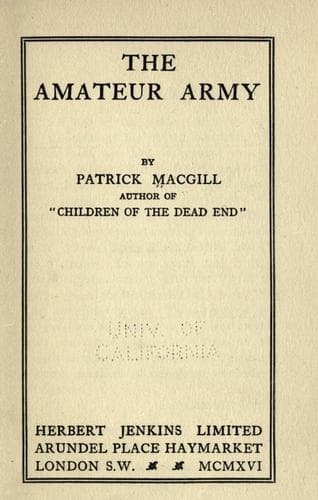
Great Britain. Army -- Military life; World War, 1914-1918 -- Personal narratives, English
Two hours' forced marching brought us to the river, a real one, with
three pontoon bridges, newly built and held firm on flat-bottomed
boats moored in mid-stream. We took our way across, and bent to the
hill on the other side. Half-way up, in a narrow lane, a wagon got
stuck in the front of our battalion, and we were forced to come to a
halt for a moment. Looking back, I could see immediately behind three
lines of men straining to the hill; farther back the same lines were
crossing the bridges and, away in the far distance, pencilled brown on
the ploughed fields, the three lines of khaki crawled along like long
threads endlessly unwinding from some invisible ball. Now and again
I could see the artillery coming into sight, only to disappear again
over a wooded knoll or into an almost invisible hollow.
Thus the division, the apparently limitless lines of men, horses, and
guns crawled on the track of the fleeing enemy. As we stood there,
held in check by the wagon, and as I looked back at the thousands of
soldiers in the rear, I felt indeed that I was a minute mite amongst
the many. And then a second thought struck me. The whole mass of men
around me was a small thing in relation to the numbers engaged in
the great war. Even I, Rifleman Something or Another, No. So-and-so,
bulked larger in the division as one of its units than the division
did in the war as a unit of the Allied Forces.
Even more interesting than divisional exercises is the mimic
warfare that is heralded by a notice in battalion orders such as the
following: "The battalion will take part in brigade exercise to-day.
Ten rounds of blank ammunition and haversack rations will be carried."
At eight o'clock in the morning whistles were blown at the bottom of
the street in which my company is billeted, and the soldiers, rubbing
the sleep from their eyes or munching the last mouthful of a hasty
breakfast, came trooping out from the snug middle-class houses
in which they are quartered. The morning was bitterly cold, and
the falling rain splashed soberly on the pavement, every drop
coming slowly to ground as if selecting a spot to rest on. The
colour-sergeant, standing at the end of the street, whistle in hand,
was in a nasty temper.
"Hurry up, you heavy-footed beggars," he yelled to the men. "The
parade takes place to-day, not to-morrow! And you, what's wrong with
your understandings?" he called to a man who came along wearing carpet
slippers.
"My boots are bad, colour," is the answer. "I cannot march in them."
"And are you goin' to march in them drorin'-room abominations?" roared
the sergeant. "Get your boots mended and grease out of it."
Public-domain text, read in full here on John Shaqi.
Reviews
Reviews
No reviews yet
Be the first to share your thoughts on this work.
Join the Discussion
Join the discussion
Sign in to leave a comment or review.
Sign InorCreate an account