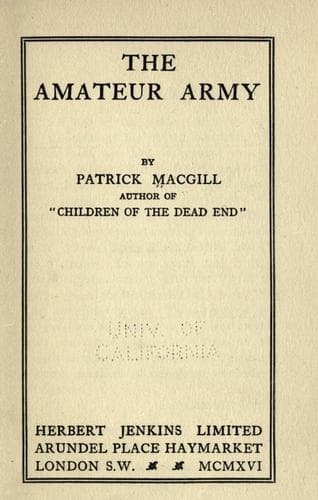
Great Britain. Army -- Military life; World War, 1914-1918 -- Personal narratives, English
"You've got a large window in the drawing-room," said the officer;
"remove that, and the men will not have to pass through the hall. I'll
let you off lightly, and leave only two."
"But I cannot keep two."
"Then I'll leave four," was the reply, and four were left.
Sadder than this, even, was the plight of the lady and gentleman at
St. Albans who told the officer that their four children were just
recovering from an attack of whooping cough. The officer, being a
wise man and anxious about the welfare of those under his care, fled
precipitately. Later he learned that there had been no whooping cough
in the house; in fact, the people who caused him to beat such a hasty
retreat were childless. He felt annoyed and discomfited; but about a
week following his first visit he called again at the house, this time
followed by six men.
"These fellows are just recovering from whooping cough," he told the
householder; "they had it bad. We didn't know what to do with them,
but, seeing that you've had whooping cough here, I feel it's the only
place where it will be safe to billet them." And he left them there.
But happenings like these were more frequent at the commencement of
the war than now. Civilians, even those of the conventional middle
class, are beginning to understand that single men in billets, to
paraphrase Kipling slightly, are remarkably like themselves.
With us, rations are served out daily at our billets; our landladies
do the cooking, and mine, an adept at the culinary art, can transform
a basin of flour and a lump of raw beef into a dish that would make an
epicurean mouth water. Even though food is badly cooked in the billet,
it has a superior flavour, which is never given it in the boilers
controlled by the company cook. Army stew has rather a notorious
reputation, as witness the inspired words of a regimental poet--one of
the 1st Surrey Rifles--in a paean of praise to his colonel:
"Long may the colonel with us bide,
His shadow ne'er grow thinner.
(It would, though, if he ever tried
Some Army stew for dinner.)"
Billeting has gained for the soldier many friends, and towns that have
become accustomed to his presence look sadly forward to the day when
he will leave them for the front, where no kind landlady will be at
hand to transform raw beef and potatoes into beef pudding or potato
pie. The working classes in particular view the future with misgiving.
The bond of sympathy between soldier and workers is stronger than that
between soldier and any other class of citizen. The houses and manners
of the well-to-do daunt most Tommies. "In their houses we feel out
of it somehow," they say. "There's nothin' we can talk about with the
swells, and 'arf the time they be askin' us about things that's no
concern of theirs at all."
Public-domain text, read in full here on John Shaqi.
Reviews
Reviews
No reviews yet
Be the first to share your thoughts on this work.
Join the Discussion
Join the discussion
Sign in to leave a comment or review.
Sign InorCreate an account