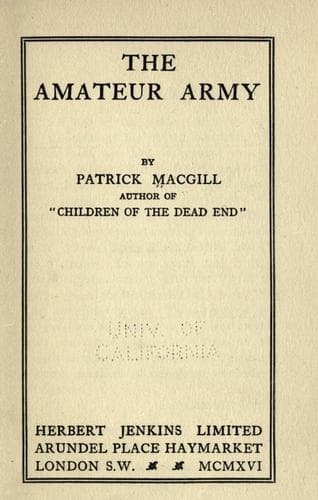
Great Britain. Army -- Military life; World War, 1914-1918 -- Personal narratives, English
When breakfast, a good hearty meal of tea, buttered toast, fried bacon
and tomatoes, was over, we went out to our places. The morning was
chilly, a cold wind splashed with hail swept along the streets and
whirled round the corners, causing the tails of our great coats to
beat sharply against our legs. It was still very dark, only a few
street-lamps were lighted and these glimmered doubtfully as if ashamed
of being noticed. Men in full marching order stamped out from every
billet, took their way to the main street, where the transport wagons,
wheels against kerbstones, horses in shafts, and drivers at reins,
stood in mathematical order, and from there on to the parade ground
where sergeants, with book in one hand and electric torch in the
other, were preparing to call the roll.
Ammunition was served out, one hundred and twenty rounds to each man,
and this was placed in the cartridge pouches, rifles were inspected
and identity discs examined by torch-light. This finished, we were
allowed to stand easy and use ground-sheets for a shelter from the
biting hail. Our blankets were already gone. The transport wagons had
disappeared and with them our field-bags. I suppose they will await
us in ---- but I anticipate, and at present all we know is that our
regiment is bound for some destination unknown where, when we arrive,
we shall have to wear two pairs of socks at our work.
We stood by till eight o'clock. The day had cleared and the sun was
shining brightly when we marched off to the station, through streets
lined with people, thoughtful men who seemed to be very sad, women who
wept and children who chattered and sang "Tipperary."
Three trains stood in the sidings by the station. Places were allotted
to the men, eight occupied each compartment, non-commissioned officers
occupied a special carriage, the officers travelled first-class.
Soon we were hurrying through England to a place unknown. Most of my
comrades were merry and a little sentimental; they sang music-hall
songs that told of home. There were seven with me in my compartment,
the Jersey youth, whom I saw kissing a weeping sweetheart in the cold
hours of the early day; Mervin, my cot-mate, who always cleaned the
rifles while I cooked breakfast in the morning; Bill, the Cockney
youth who never is so happy as when getting the best of an argument
in the coffee-shop of which I have already spoken, and the Oxford man.
The other three were almost complete strangers to me, they have just
been drafted into our regiment; one was very fat and reminded me of a
Dickens character in _Pickwick Papers_; another who soon fell asleep,
his head warm in a Balaclava helmet, was a tall, strapping youth with
large muscular hands, which betoken manual labour, and the last was a
slightly-built boy with a budding moustache which seemed to have been
waxed at one end. We noticed this, and the fat soldier said that the
wax had melted from the few lonely hairs on the other side of the lip.
Public-domain text, read in full here on John Shaqi.
Reviews
Reviews
No reviews yet
Be the first to share your thoughts on this work.
Join the Discussion
Join the discussion
Sign in to leave a comment or review.
Sign InorCreate an account