It has also been impossible, on the same grounds, to criticise
the statements here made; the greater part are, like those in the
biographical portion, frankly impossible, when not mutually exclusive. It
is needless to say that the author accepts the whole with all the Attic
salt at his disposal.
Another anomaly that may strike the reader is the fact that various names
are used to designate the Emperor. Tristran remarks that “they are as
many as the hydra has heads.” The present idea is to use the titles
which the boy bore at the different stages of his life, rather than apply
to him on all occasions the nickname which was attached to him after his
death.
In the earlier part of the work I have referred to the youth as Varius
and Bassianus, the two names which appear most frequently, in reference
to his reputed fathers, but have neglected Avitus, by which title he is
occasionally known, in reference to his grandfather, as also that of
Lupus, which is sometimes found in Dion, because, as Dr. Wotton remarks,
there is no means of finding out whether he was so called (if ever he was
given the name at all) on account of some ancestry, by reason of a false
reading, or on account of some other matter now long laid to rest.
After the Proclamation, I have preferred to call the Emperor by his
official name, Marcus Aurelius Antoninus, or Antonine for short, as
this is the only manner in which the coins, inscriptions, and documents
describe him. After his death, it seems allowable to give him the
nickname which his relations and later biographers have applied to
him, namely, the latinised form of the name of his God. I have nowhere
adopted the later Greek spelling or adaptation, Heliogabalus, either
when referring to the God of the Emesans or to the Emperor himself. The
only form in which the name occurs in inscriptions is in describing
the Emperor as “Priest of Elagabal” or the Sun. Lampridius certainly
Hellenised its form a century later, on what grounds is by no means
clear, when one realises that neither the boy nor his God had any
trace of Greek blood, tradition, or philosophy about them, and that
the identification of a particular Syrian monotheism with Mithraism
or general Sun worship is not universally admitted as a necessary
consequence, either in the case of Elagabal, Jehovah, or indeed in that
of any of the other “El” claimants to exclusiveness, though the balance
of probability may lie on the side of the identification. It is further
unnecessary to drag in the Hellenised form of the Emperor’s name in
order to pander to a popular and erroneous conception of the reign,
which conception this book is designed to combat and generally offend.
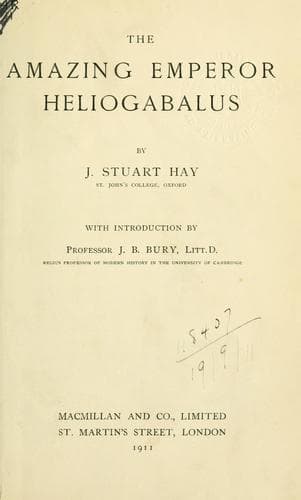
Heliogabalus is nevertheless the sole title by which this Emperor is
known to the world at large, in consequence of which I have allowed the
name to stand on the title-page, chiefly in order that Mrs. Grundy’s
prurient mind may know, before she buys or borrows this volume, that it
Public-domain text, read in full here on John Shaqi.
Reviews
Reviews
No reviews yet
Be the first to share your thoughts on this work.
Join the Discussion
Join the discussion
Sign in to leave a comment or review.
Sign InorCreate an account