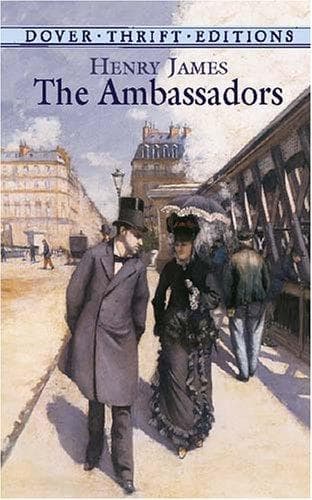
Americans -- France -- Fiction; Man-woman relationships -- Fiction; Paris (France) -- Fiction; Psychological fiction; Young men -- Fiction
“There must have been stuff in him? Oh yes, there was stuff indeed, and
much more of it than ever showed, I dare say, at home. Still, you
know,” the young man in all fairness developed, “there was room for
her, and that’s where she came in. She saw her chance and took it.
That’s what strikes me as having been so fine. But of course,” he wound
up, “he liked her first.”
“Naturally,” said Strether.
“I mean that they first met somehow and somewhere—I believe in some
American house—and she, without in the least then intending it, made
her impression. Then with time and opportunity he made his; and after
_that_ she was as bad as he.”
Strether vaguely took it up. “As ‘bad’?”
“She began, that is, to care—to care very much. Alone, and in her
horrid position, she found it, when once she had started, an interest.
It was, it is, an interest, and it did—it continues to do—a lot for
herself as well. So she still cares. She cares in fact,” said little
Bilham thoughtfully “more.”
Strether’s theory that it was none of his business was somehow not
damaged by the way he took this. “More, you mean, than he?” On which
his companion looked round at him, and now for an instant their eyes
met. “More than he?” he repeated.
Little Bilham, for as long, hung fire. “Will you never tell any one?”
Strether thought. “Whom should I tell?”
“Why I supposed you reported regularly—”
“To people at home?”—Strether took him up. “Well, I won’t tell them
this.”
The young man at last looked away. “Then she does now care more than
he.”
“Oh!” Strether oddly exclaimed.
But his companion immediately met it. “Haven’t you after all had your
impression of it? That’s how you’ve got hold of him.”
“Ah but I haven’t got hold of him!”
“Oh I say!” But it was all little Bilham said.
“It’s at any rate none of my business. I mean,” Strether explained,
“nothing else than getting hold of him is.” It appeared, however, to
strike him as his business to add: “The fact remains nevertheless that
she has saved him.”
Little Bilham just waited. “I thought that was what _you_ were to do.”
But Strether had his answer ready. “I’m speaking—in connexion with
her—of his manners and morals, his character and life. I’m speaking of
him as a person to deal with and talk with and live with—speaking of
him as a social animal.”
“And isn’t it as a social animal that you also want him?”
“Certainly; so that it’s as if she had saved him _for_ us.”
“It strikes you accordingly then,” the young man threw out, “as for you
all to save _her?_”
“Oh for us ‘all’—!” Strether could but laugh at that. It brought him
back, however, to the point he had really wished to make. “They’ve
accepted their situation—hard as it is. They’re not free—at least she’s
not; but they take what’s left to them. It’s a friendship, of a
beautiful sort; and that’s what makes them so strong. They’re straight,
they feel; and they keep each other up. It’s doubtless she, however,
who, as you yourself have hinted, feels it most.”
Public-domain text, read in full here on John Shaqi.
Reviews
Reviews
No reviews yet
Be the first to share your thoughts on this work.
Elsewhere in the archive
Join the Discussion
Join the discussion
Sign in to leave a comment or review.
Sign InorCreate an account