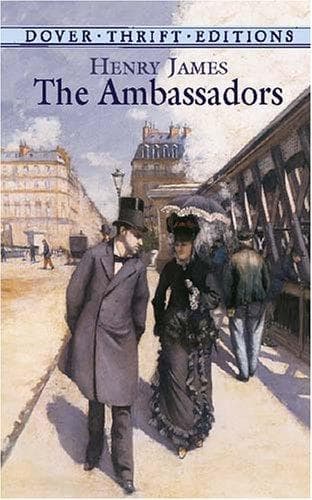
Americans -- France -- Fiction; Man-woman relationships -- Fiction; Paris (France) -- Fiction; Psychological fiction; Young men -- Fiction
Little Bilham appeared to wonder what he had hinted. “Feels most that
they’re straight?”
“Well, feels that _she_ is, and the strength that comes from it. She
keeps _him_ up—she keeps the whole thing up. When people are able to
it’s fine. She’s wonderful, wonderful, as Miss Barrace says; and he is,
in his way, too; however, as a mere man, he may sometimes rebel and not
feel that he finds his account in it. She has simply given him an
immense moral lift, and what that can explain is prodigious. That’s why
I speak of it as a situation. It _is_ one, if there ever was.” And
Strether, with his head back and his eyes on the ceiling, seemed to
lose himself in the vision of it.
His companion attended deeply. “You state it much better than I could.”
“Oh you see it doesn’t concern you.”
Little Bilham considered. “I thought you said just now that it doesn’t
concern you either.”
“Well, it doesn’t a bit as Madame de Vionnet’s affair. But as we were
again saying just now, what did I come out for but to save him?”
“Yes—to remove him.”
“To save him _by_ removal; to win him over to _himself_ thinking it
best he shall take up business—thinking he must immediately do
therefore what’s necessary to that end.”
“Well,” said little Bilham after a moment, “you _have_ won him over. He
does think it best. He has within a day or two again said to me as
much.”
“And that,” Strether asked, “is why you consider that he cares less
than she?”
“Cares less for her than she for him? Yes, that’s one of the reasons.
But other things too have given me the impression. A man, don’t you
think?” little Bilham presently pursued, “_Can’t_, in such conditions,
care so much as a woman. It takes different conditions to make him, and
then perhaps he cares more. Chad,” he wound up, “has his possible
future before him.”
“Are you speaking of his business future?”
“No—on the contrary; of the other, the future of what you so justly
call their situation. M. de Vionnet may live for ever.”
“So that they can’t marry?”
The young man waited a moment. “Not being able to marry is all they’ve
with any confidence to look forward to. A woman—a particular woman—may
stand that strain. But can a man?” he propounded.
Strether’s answer was as prompt as if he had already, for himself,
worked it out. “Not without a very high ideal of conduct. But that’s
just what we’re attributing to Chad. And how, for that matter,” he
mused, “does his going to America diminish the particular strain?
Wouldn’t it seem rather to add to it?”
“Out of sight out of mind!” his companion laughed. Then more bravely:
“Wouldn’t distance lessen the torment?” But before Strether could
reply, “The thing is, you see, Chad ought to marry!” he wound up.
Strether, for a little, appeared to think of it. “If you talk of
torments you don’t diminish mine!” he then broke out. The next moment
he was on his feet with a question. “He ought to marry whom?”
Little Bilham rose more slowly. “Well, some one he _can_—some
thoroughly nice girl.”
Public-domain text, read in full here on John Shaqi.
Reviews
Reviews
No reviews yet
Be the first to share your thoughts on this work.
Elsewhere in the archive
Join the Discussion
Join the discussion
Sign in to leave a comment or review.
Sign InorCreate an account