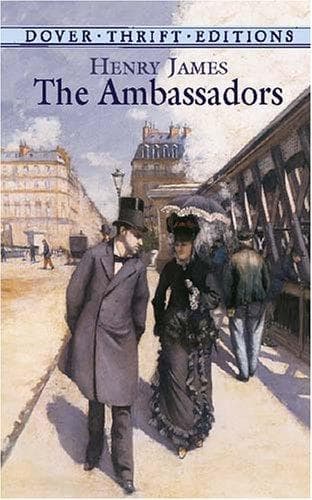
Americans -- France -- Fiction; Man-woman relationships -- Fiction; Paris (France) -- Fiction; Psychological fiction; Young men -- Fiction
Strether’s eyes, as they stood together, turned again to Jeanne. “Do
you mean _her?_”
His friend made a sudden strange face. “After being in love with her
mother? No.”
“But isn’t it exactly your idea that he _isn’t_ in love with her
mother?”
His friend once more had a pause. “Well, he isn’t at any rate in love
with Jeanne.”
“I dare say not.”
“How _can_ he be with any other woman?”
“Oh that I admit. But being in love isn’t, you know, here”—little
Bilham spoke in friendly reminder—“thought necessary, in strictness,
for marriage.”
“And what torment—to call a torment—can there ever possibly be with a
woman like that?” As if from the interest of his own question Strether
had gone on without hearing. “Is it for her to have turned a man out so
wonderfully, too, only for somebody else?” He appeared to make a point
of this, and little Bilham looked at him now. “When it’s for each other
that people give things up they don’t miss them.” Then he threw off as
with an extravagance of which he was conscious: “Let them face the
future together!”
Little Bilham looked at him indeed. “You mean that after all he
shouldn’t go back?”
“I mean that if he gives her up—!”
“Yes?”
“Well, he ought to be ashamed of himself.” But Strether spoke with a
sound that might have passed for a laugh.
Volume II
Book Seventh
I
It wasn’t the first time Strether had sat alone in the great dim
church—still less was it the first of his giving himself up, so far as
conditions permitted, to its beneficent action on his nerves. He had
been to Notre Dame with Waymarsh, he had been there with Miss Gostrey,
he had been there with Chad Newsome, and had found the place, even in
company, such a refuge from the obsession of his problem that, with
renewed pressure from that source, he had not unnaturally recurred to a
remedy meeting the case, for the moment, so indirectly, no doubt, but
so relievingly. He was conscious enough that it was only for the
moment, but good moments—if he could call them good—still had their
value for a man who by this time struck himself as living almost
disgracefully from hand to mouth. Having so well learnt the way, he had
lately made the pilgrimage more than once by himself—had quite stolen
off, taking an unnoticed chance and making no point of speaking of the
adventure when restored to his friends.
Public-domain text, read in full here on John Shaqi.
Reviews
Reviews
No reviews yet
Be the first to share your thoughts on this work.
Elsewhere in the archive
Join the Discussion
Join the discussion
Sign in to leave a comment or review.
Sign InorCreate an account