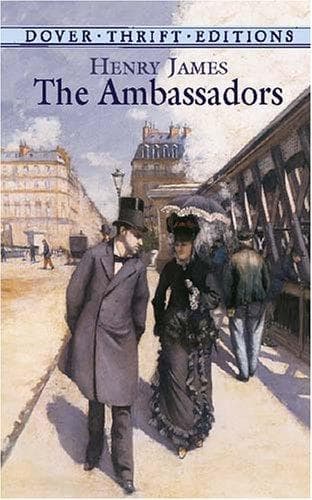
Americans -- France -- Fiction; Man-woman relationships -- Fiction; Paris (France) -- Fiction; Psychological fiction; Young men -- Fiction
It marked for himself the flight of time, or at any rate what he was
pleased to think of with irony and pity as the rush of experience; it
having been but the day before yesterday that he sat at her feet and
held on by her garment and was fed by her hand. It was the proportions
that were changed, and the proportions were at all times, he
philosophised, the very conditions of perception, the terms of thought.
It was as if, with her effective little _entresol_ and and her wide
acquaintance, her activities, varieties, promiscuities, the duties and
devotions that took up nine tenths of her time and of which he got,
guardedly, but the side-wind—it was as if she had shrunk to a secondary
element and had consented to the shrinkage with the perfection of tact.
This perfection had never failed her; it had originally been greater
than his prime measure for it; it had kept him quite apart, kept him
out of the shop, as she called her huge general acquaintance, made
their commerce as quiet, as much a thing of the home alone—the opposite
of the shop—as if she had never another customer. She had been
wonderful to him at first, with the memory of her little _entresol_,
the image to which, on most mornings at that time, his eyes directly
opened; but now she mainly figured for him as but part of the bristling
total—though of course always as a person to whom he should never cease
to be indebted. It would never be given to him certainly to inspire a
greater kindness. She had decked him out for others, and he saw at this
point at least nothing she would ever ask for. She only wondered and
questioned and listened, rendering him the homage of a wistful
speculation. She expressed it repeatedly; he was already far beyond
her, and she must prepare herself to lose him. There was but one little
chance for her.
Often as she had said it he met it—for it was a touch he liked—each
time the same way. “My coming to grief?”
“Yes—then I might patch you up.”
“Oh for my real smash, if it takes place, there will be no patching.”
“But you surely don’t mean it will kill you.”
“No—worse. It will make me old.”
“Ah nothing can do that! The wonderful and special thing about you is
that you _are_, at this time of day, youth.” Then she always made,
further, one of those remarks that she had completely ceased to adorn
with hesitations or apologies, and that had, by the same token, in
spite of their extreme straightness, ceased to produce in Strether the
least embarrassment. She made him believe them, and they became thereby
as impersonal as truth itself. “It’s just your particular charm.”
Public-domain text, read in full here on John Shaqi.
Reviews
Reviews
No reviews yet
Be the first to share your thoughts on this work.
Elsewhere in the archive
Join the Discussion
Join the discussion
Sign in to leave a comment or review.
Sign InorCreate an account