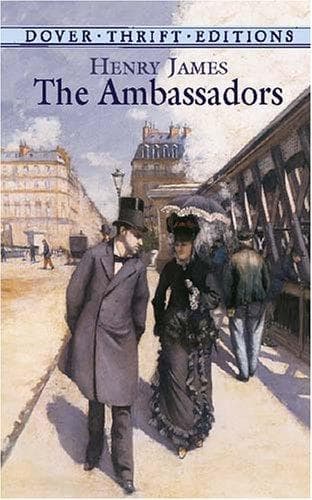
Americans -- France -- Fiction; Man-woman relationships -- Fiction; Paris (France) -- Fiction; Psychological fiction; Young men -- Fiction
His answer too was always the same. “Of course I’m youth—youth for the
trip to Europe. I began to be young, or at least to get the benefit of
it, the moment I met you at Chester, and that’s what has been taking
place ever since. I never had the benefit at the proper time—which
comes to saying that I never had the thing itself. I’m having the
benefit at this moment; I had it the other day when I said to Chad
‘Wait’; I shall have it still again when Sarah Pocock arrives. It’s a
benefit that would make a poor show for many people; and I don’t know
who else but you and I, frankly, could begin to see in it what I feel.
I don’t get drunk; I don’t pursue the ladies; I don’t spend money; I
don’t even write sonnets. But nevertheless I’m making up late for what
I didn’t have early. I cultivate my little benefit in my own little
way. It amuses me more than anything that has happened to me in all my
life. They may say what they like—it’s my surrender, it’s my tribute,
to youth. One puts that in where one can—it has to come in somewhere,
if only out of the lives, the conditions, the feelings of other
persons. Chad gives me the sense of it, for all his grey hairs, which
merely make it solid in him and safe and serene; and _she_ does the
same, for all her being older than he, for all her marriageable
daughter, her separated husband, her agitated history. Though they’re
young enough, my pair, I don’t say they’re, in the freshest way, their
_own_ absolutely prime adolescence; for that has nothing to do with it.
The point is that they’re mine. Yes, they’re my youth; since somehow at
the right time nothing else ever was. What I meant just now therefore
is that it would all go—go before doing its work—if they were to fail
me.”
On which, just here, Miss Gostrey inveterately questioned. “What do
you, in particular, call its work?”
“Well, to see me through.”
“But through what?”—she liked to get it all out of him.
“Why through this experience.” That was all that would come.
It regularly gave her none the less the last word. “Don’t you remember
how in those first days of our meeting it was _I_ who was to see you
through?”
“Remember? Tenderly, deeply”—he always rose to it. “You’re just doing
your part in letting me maunder to you thus.”
“Ah don’t speak as if my part were small; since whatever else fails
you—”
“_You_ won’t, ever, ever, ever?”—he thus took her up. “Oh I beg your
pardon; you necessarily, you inevitably _will_. Your conditions—that’s
what I mean—won’t allow me anything to do for you.”
“Let alone—I see what you mean—that I’m drearily dreadfully old. I
_am_, but there’s a service—possible for you to render—that I know, all
the same, I shall think of.”
“And what will it be?”
This, in fine, however, she would never tell him. “You shall hear only
if your smash takes place. As that’s really out of the question, I
won’t expose myself”—a point at which, for reasons of his own, Strether
ceased to press.
Public-domain text, read in full here on John Shaqi.
Reviews
Reviews
No reviews yet
Be the first to share your thoughts on this work.
Elsewhere in the archive
Join the Discussion
Join the discussion
Sign in to leave a comment or review.
Sign InorCreate an account