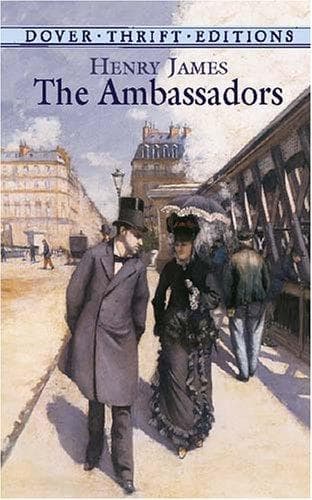
Americans -- France -- Fiction; Man-woman relationships -- Fiction; Paris (France) -- Fiction; Psychological fiction; Young men -- Fiction
He came round, for publicity—it was the easiest thing—to the idea that
his smash _was_ out of the question, and this rendered idle the
discussion of what might follow it. He attached an added importance, as
the days elapsed, to the arrival of the Pococks; he had even a shameful
sense of waiting for it insincerely and incorrectly. He accused himself
of making believe to his own mind that Sarah’s presence, her
impression, her judgement would simplify and harmonise, he accused
himself of being so afraid of what they _might_ do that he sought
refuge, to beg the whole question, in a vain fury. He had abundantly
seen at home what they were in the habit of doing, and he had not at
present the smallest ground. His clearest vision was when he made out
that what he most desired was an account more full and free of Mrs.
Newsome’s state of mind than any he felt he could now expect from
herself; that calculation at least went hand in hand with the sharp
consciousness of wishing to prove to himself that he was not afraid to
look his behaviour in the face. If he was by an inexorable logic to pay
for it he was literally impatient to know the cost, and he held himself
ready to pay in instalments. The first instalment would be precisely
this entertainment of Sarah; as a consequence of which moreover, he
should know vastly better how he stood.
Book Eighth
I
Strether rambled alone during these few days, the effect of the
incident of the previous week having been to simplify in a marked
fashion his mixed relations with Waymarsh. Nothing had passed between
them in reference to Mrs. Newsome’s summons but that our friend had
mentioned to his own the departure of the deputation actually at
sea—giving him thus an opportunity to confess to the occult
intervention he imputed to him. Waymarsh however in the event confessed
to nothing; and though this falsified in some degree Strether’s
forecast the latter amusedly saw in it the same depth of good
conscience out of which the dear man’s impertinence had originally
sprung. He was patient with the dear man now and delighted to observe
how unmistakeably he had put on flesh; he felt his own holiday so
successfully large and free that he was full of allowances and
charities in respect to those cabined and confined: his instinct toward
a spirit so strapped down as Waymarsh’s was to walk round it on tiptoe
for fear of waking it up to a sense of losses by this time
irretrievable. It was all very funny he knew, and but the difference,
as he often said to himself, of tweedledum and tweedledee—an
emancipation so purely comparative that it was like the advance of the
door-mat on the scraper; yet the present crisis was happily to profit
by it and the pilgrim from Milrose to know himself more than ever in
the right.
Public-domain text, read in full here on John Shaqi.
Reviews
Reviews
No reviews yet
Be the first to share your thoughts on this work.
Elsewhere in the archive
Join the Discussion
Join the discussion
Sign in to leave a comment or review.
Sign InorCreate an account