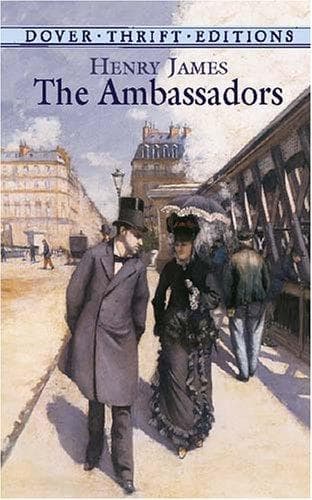
Americans -- France -- Fiction; Man-woman relationships -- Fiction; Paris (France) -- Fiction; Psychological fiction; Young men -- Fiction
He glanced at such a contingency, but it failed to hold him long when
once he had reflected that he would have been silly, in this case, with
Maria Gostrey and little Bilham, with Madame de Vionnet and little
Jeanne, with Lambert Strether, in fine, and above all with Chad Newsome
himself. Wouldn’t it be found to have made more for reality to be silly
with these persons than sane with Sarah and Jim? Jim in fact, he
presently made up his mind, was individually out of it; Jim didn’t
care; Jim hadn’t come out either for Chad or for him; Jim in short left
the moral side to Sally and indeed simply availed himself now, for the
sense of recreation, of the fact that he left almost everything to
Sally. He was nothing compared to Sally, and not so much by reason of
Sally’s temper and will as by that of her more developed type and
greater acquaintance with the world. He quite frankly and serenely
confessed, as he sat there with Strether, that he felt his type hang
far in the rear of his wife’s and still further, if possible, in the
rear of his sister’s. Their types, he well knew, were recognised and
acclaimed; whereas the most a leading Woollett business-man could hope
to achieve socially, and for that matter industrially, was a certain
freedom to play into this general glamour.
The impression he made on our friend was another of the things that
marked our friend’s road. It was a strange impression, especially as so
soon produced; Strether had received it, he judged, all in the twenty
minutes; it struck him at least as but in a minor degree the work of
the long Woollett years. Pocock was normally and consentingly though
not quite wittingly out of the question. It was despite his being
normal; it was despite his being cheerful; it was despite his being a
leading Woollett business-man; and the determination of his fate left
him thus perfectly usual—as everything else about it was clearly, to
his sense, not less so. He seemed to say that there was a whole side of
life on which the perfectly usual _was_ for leading Woollett
business-men to be out of the question. He made no more of it than
that, and Strether, so far as Jim was concerned, desired to make no
more. Only Strether’s imagination, as always, worked, and he asked
himself if this side of life were not somehow connected, for those who
figured on it with the fact of marriage. Would _his_ relation to it,
had he married ten years before, have become now the same as Pocock’s?
Might it even become the same should he marry in a few months? Should
he ever know himself as much out of the question for Mrs. Newsome as
Jim knew himself—in a dim way—for Mrs. Jim?
Public-domain text, read in full here on John Shaqi.
Reviews
Reviews
No reviews yet
Be the first to share your thoughts on this work.
Elsewhere in the archive
Join the Discussion
Join the discussion
Sign in to leave a comment or review.
Sign InorCreate an account