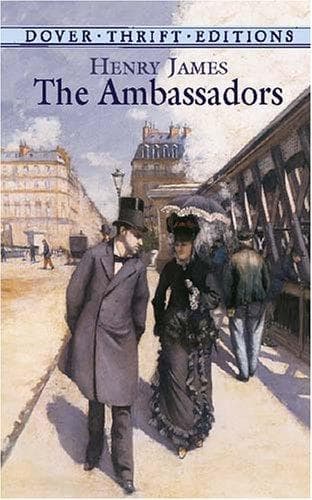
Americans -- France -- Fiction; Man-woman relationships -- Fiction; Paris (France) -- Fiction; Psychological fiction; Young men -- Fiction
To turn his eyes in that direction was to be personally reassured; he
was different from Pocock; he had affirmed himself differently and was
held after all in higher esteem. What none the less came home to him,
however, at this hour, was that the society over there, that of which
Sarah and Mamie—and, in a more eminent way, Mrs. Newsome herself—were
specimens, was essentially a society of women, and that poor Jim wasn’t
in it. He himself Lambert Strether, _was_ as yet in some degree—which
was an odd situation for a man; but it kept coming back to him in a
whimsical way that he should perhaps find his marriage had cost him his
place. This occasion indeed, whatever that fancy represented, was not a
time of sensible exclusion for Jim, who was in a state of manifest
response to the charm of his adventure. Small and fat and constantly
facetious, straw-coloured and destitute of marks, he would have been
practically indistinguishable hadn’t his constant preference for
light-grey clothes, for white hats, for very big cigars and very little
stories, done what it could for his identity. There were signs in him,
though none of them plaintive, of always paying for others; and the
principal one perhaps was just this failure of type. It was with this
that he paid, rather than with fatigue or waste; and also doubtless a
little with the effort of humour—never irrelevant to the conditions, to
the relations, with which he was acquainted.
He gurgled his joy as they rolled through the happy streets; he
declared that his trip was a regular windfall, and that he wasn’t
there, he was eager to remark, to hang back from anything: he didn’t
know quite what Sally had come for, but _he_ had come for a good time.
Strether indulged him even while wondering if what Sally wanted her
brother to go back for was to become like her husband. He trusted that
a good time was to be, out and out, the programme for all of them; and
he assented liberally to Jim’s proposal that, disencumbered and
irresponsible—his things were in the omnibus with those of the
others—they should take a further turn round before going to the hotel.
It wasn’t for _him_ to tackle Chad—it was Sally’s job; and as it would
be like her, he felt, to open fire on the spot, it wouldn’t be amiss of
them to hold off and give her time. Strether, on his side, only asked
to give her time; so he jogged with his companion along boulevards and
avenues, trying to extract from meagre material some forecast of his
catastrophe. He was quick enough to see that Jim Pocock declined
judgement, had hovered quite round the outer edge of discussion and
anxiety, leaving all analysis of their question to the ladies alone and
now only feeling his way toward some small droll cynicism. It broke out
afresh, the cynicism—it had already shown a flicker—in a but slightly
deferred: “Well, hanged if I would if _I_ were he!”
“You mean you wouldn’t in Chad’s place—?”
Public-domain text, read in full here on John Shaqi.
Reviews
Reviews
No reviews yet
Be the first to share your thoughts on this work.
Elsewhere in the archive
Join the Discussion
Join the discussion
Sign in to leave a comment or review.
Sign InorCreate an account