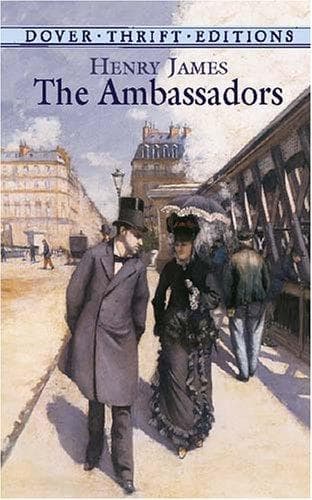
Americans -- France -- Fiction; Man-woman relationships -- Fiction; Paris (France) -- Fiction; Psychological fiction; Young men -- Fiction
As the door of Mrs. Pocock’s salon was pushed open for him, the next
day, well before noon, he was reached by a voice with a charming sound
that made him just falter before crossing the threshold. Madame de
Vionnet was already on the field, and this gave the drama a quicker
pace than he felt it as yet—though his suspense had increased—in the
power of any act of his own to do. He had spent the previous evening
with all his old friends together yet he would still have described
himself as quite in the dark in respect to a forecast of their
influence on his situation. It was strange now, none the less, that in
the light of this unexpected note of her presence he felt Madame de
Vionnet a part of that situation as she hadn’t even yet been. She was
alone, he found himself assuming, with Sarah, and there was a bearing
in that—somehow beyond his control—on his personal fate. Yet she was
only saying something quite easy and independent—the thing she had
come, as a good friend of Chad’s, on purpose to say. “There isn’t
anything at all—? I should be so delighted.”
It was clear enough, when they were there before him, how she had been
received. He saw this, as Sarah got up to greet him, from something
fairly hectic in Sarah’s face. He saw furthermore that they weren’t, as
had first come to him, alone together; he was at no loss as to the
identity of the broad high back presented to him in the embrasure of
the window furthest from the door. Waymarsh, whom he had to-day not yet
seen, whom he only knew to have left the hotel before him, and who had
taken part, the night previous, on Mrs. Pocock’s kind invitation,
conveyed by Chad, in the entertainment, informal but cordial, promptly
offered by that lady—Waymarsh had anticipated him even as Madame de
Vionnet had done, and, with his hands in his pockets and his attitude
unaffected by Strether’s entrance, was looking out, in marked
detachment, at the Rue de Rivoli. The latter felt it in the air—it was
immense how Waymarsh could mark things—-that he had remained deeply
dissociated from the overture to their hostess that we have recorded on
Madame de Vionnet’s side. He had, conspicuously, tact, besides a stiff
general view; and this was why he had left Mrs. Pocock to struggle
alone. He would outstay the visitor; he would unmistakeably wait; to
what had he been doomed for months past but waiting? Therefore she was
to feel that she had him in reserve. What support she drew from this
was still to be seen, for, although Sarah was vividly bright, she had
given herself up for the moment to an ambiguous flushed formalism. She
had had to reckon more quickly than she expected; but it concerned her
first of all to signify that she was not to be taken unawares. Strether
arrived precisely in time for her showing it. “Oh you’re too good; but
I don’t think I feel quite helpless. I have my brother—and these
American friends. And then you know I’ve been to Paris. I _know_
Public-domain text, read in full here on John Shaqi.
Reviews
Reviews
No reviews yet
Be the first to share your thoughts on this work.
Elsewhere in the archive
Join the Discussion
Join the discussion
Sign in to leave a comment or review.
Sign InorCreate an account