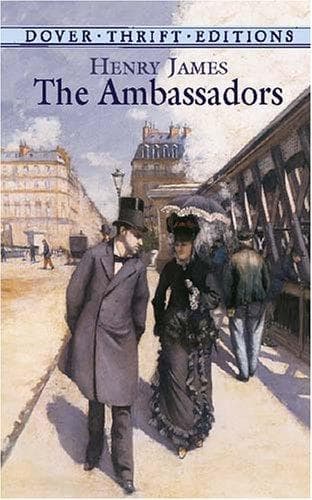
Americans -- France -- Fiction; Man-woman relationships -- Fiction; Paris (France) -- Fiction; Psychological fiction; Young men -- Fiction
Paris,” said Sally Pocock in a tone that breathed a certain chill on
Strether’s heart.
“Ah but a woman, in this tiresome place where everything’s always
changing, a woman of good will,” Madame de Vionnet threw off, “can
always help a woman. I’m sure you ‘know’—but we know perhaps different
things.” She too, visibly, wished to make no mistake; but it was a fear
of a different order and more kept out of sight. She smiled in welcome
at Strether; she greeted him more familiarly than Mrs. Pocock; she put
out her hand to him without moving from her place; and it came to him
in the course of a minute and in the oddest way that—yes,
positively—she was giving him over to ruin. She was all kindness and
ease, but she couldn’t help so giving him; she was exquisite, and her
being just as she was poured for Sarah a sudden rush of meaning into
his own equivocations. How could she know how she was hurting him? She
wanted to show as simple and humble—in the degree compatible with
operative charm; but it was just this that seemed to put him on her
side. She struck him as dressed, as arranged, as prepared infinitely to
conciliate—with the very poetry of good taste in her view of the
conditions of her early call. She was ready to advise about dressmakers
and shops; she held herself wholly at the disposition of Chad’s family.
Strether noticed her card on the table—her coronet and her
“Comtesse”—and the imagination was sharp in him of certain private
adjustments in Sarah’s mind. She had never, he was sure, sat with a
“Comtesse” before, and such was the specimen of that class he had been
keeping to play on her. She had crossed the sea very particularly for a
look at her; but he read in Madame de Vionnet’s own eyes that this
curiosity hadn’t been so successfully met as that she herself wouldn’t
now have more than ever need of him. She looked much as she had looked
to him that morning at Notre Dame; he noted in fact the suggestive
sameness of her discreet and delicate dress. It seemed to speak—perhaps
a little prematurely or too finely—of the sense in which she would help
Mrs. Pocock with the shops. The way that lady took her in, moreover,
added depth to his impression of what Miss Gostrey, by their common
wisdom, had escaped. He winced as he saw himself but for that timely
prudence ushering in Maria as a guide and an example. There was however
a touch of relief for him in his glimpse, so far as he had got it, of
Sarah’s line. She “knew Paris.” Madame de Vionnet had, for that matter,
lightly taken this up. “Ah then you’ve a turn for that, an affinity
that belongs to your family. Your brother, though his long experience
makes a difference, I admit, has become one of us in a marvellous way.”
And she appealed to Strether in the manner of a woman who could always
glide off with smoothness into another subject. Wasn’t _he_ struck with
the way Mr. Newsome had made the place his own, and hadn’t he been in a
position to profit by his friend’s wondrous expertness?
Public-domain text, read in full here on John Shaqi.
Reviews
Reviews
No reviews yet
Be the first to share your thoughts on this work.
Elsewhere in the archive
Join the Discussion
Join the discussion
Sign in to leave a comment or review.
Sign InorCreate an account