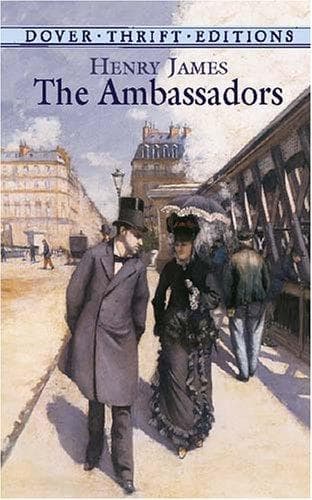
Americans -- France -- Fiction; Man-woman relationships -- Fiction; Paris (France) -- Fiction; Psychological fiction; Young men -- Fiction
It seems as if it were what would do; really, really all one could
wish. There are only two or three points to be settled—they depend on
her father. But this time I think we’re safe.”
Strether, consciously gaping a little, had fairly hung upon her lips.
“I hope so with all my heart.” And then he permitted himself: “Does
nothing depend on _her?_”
“Ah naturally; everything did. But she’s pleased _comme tout_. She has
been perfectly free; and he—our young friend—is really a combination. I
quite adore him.”
Strether just made sure. “You mean your future son-in-law?”
“Future if we all bring it off.”
“Ah well,” said Strether decorously, “I heartily hope you may.” There
seemed little else for him to say, though her communication had the
oddest effect on him. Vaguely and confusedly he was troubled by it;
feeling as if he had even himself been concerned in something deep and
dim. He had allowed for depths, but these were greater: and it was as
if, oppressively—indeed absurdly—he was responsible for what they had
now thrown up to the surface. It was—through something ancient and cold
in it—what he would have called the real thing. In short his hostess’s
news, though he couldn’t have explained why, was a sensible shock, and
his oppression a weight he felt he must somehow or other immediately
get rid of. There were too many connexions missing to make it tolerable
he should do anything else. He was prepared to suffer—before his own
inner tribunal—for Chad; he was prepared to suffer even for Madame de
Vionnet. But he wasn’t prepared to suffer for the little girl. So now
having said the proper thing, he wanted to get away. She held him an
instant, however, with another appeal.
“Do I seem to you very awful?”
“Awful? Why so?” But he called it to himself, even as he spoke, his
biggest insincerity yet.
“Our arrangements are so different from yours.”
“Mine?” Oh he could dismiss that too! “I haven’t any arrangements.”
“Then you must accept mine; all the more that they’re excellent.
They’re founded on a _vieille sagesse_. There will be much more, if all
goes well, for you to hear and to know, and everything, believe me, for
you to like. Don’t be afraid; you’ll be satisfied.” Thus she could talk
to him of what, of her innermost life—for that was what it came to—he
must “accept”; thus she could extraordinarily speak as if in such an
affair his being satisfied had an importance. It was all a wonder and
made the whole case larger. He had struck himself at the hotel, before
Sarah and Waymarsh, as being in her boat; but where on earth was he
now? This question was in the air till her own lips quenched it with
another. “And do you suppose _he_—who loves her so—would do anything
reckless or cruel?”
He wondered what he supposed. “Do you mean your young man—?”
“I mean yours. I mean Mr. Newsome.” It flashed for Strether the next
moment a finer light, and the light deepened as she went on. “He takes,
thank God, the truest tenderest interest in her.”
Public-domain text, read in full here on John Shaqi.
Reviews
Reviews
No reviews yet
Be the first to share your thoughts on this work.
Elsewhere in the archive
Join the Discussion
Join the discussion
Sign in to leave a comment or review.
Sign InorCreate an account