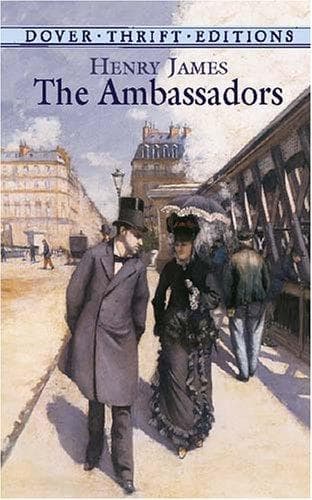
Americans -- France -- Fiction; Man-woman relationships -- Fiction; Paris (France) -- Fiction; Psychological fiction; Young men -- Fiction
It deepened indeed. “Oh I’m sure of that!”
“You were talking,” she said, “about one’s trusting him. You see then
how I do.”
He waited a moment—it all came. “I see—I see.” He felt he really did
see.
“He wouldn’t hurt her for the world, nor—assuming she marries at
all—risk anything that might make against her happiness. And—willingly,
at least—he would never hurt _me_.”
Her face, with what he had by this time grasped, told him more than her
words; whether something had come into it, or whether he only read
clearer, her whole story—what at least he then took for such—reached
out to him from it. With the initiative she now attributed to Chad it
all made a sense, and this sense—a light, a lead, was what had abruptly
risen before him. He wanted, once more, to get off with these things;
which was at last made easy, a servant having, for his assistance, on
hearing voices in the hall, just come forward. All that Strether had
made out was, while the man opened the door and impersonally waited,
summed up in his last word. “I don’t think, you know, Chad will tell me
anything.”
“No—perhaps not yet.”
“And I won’t as yet speak to him.”
“Ah that’s as you’ll think best. You must judge.”
She had finally given him her hand, which he held a moment. “How _much_
I have to judge!”
“Everything,” said Madame de Vionnet: a remark that was indeed—with the
refined disguised suppressed passion of her face—what he most carried
away.
II
So far as a direct approach was concerned Sarah had neglected him, for
the week now about to end, with a civil consistency of chill that,
giving him a higher idea of her social resource, threw him back on the
general reflexion that a woman could always be amazing. It indeed
helped a little to console him that he felt sure she had for the same
period also left Chad’s curiosity hanging; though on the other hand,
for his personal relief, Chad could at least go through the various
motions—and he made them extraordinarily numerous—of seeing she had a
good time. There wasn’t a motion on which, in her presence, poor
Strether could so much as venture, and all he could do when he was out
of it was to walk over for a talk with Maria. He walked over of course
much less than usual, but he found a special compensation in a certain
half-hour during which, toward the close of a crowded empty expensive
day, his several companions seemed to him so disposed of as to give his
forms and usages a rest. He had been with them in the morning and had
nevertheless called on the Pococks in the afternoon; but their whole
group, he then found, had dispersed after a fashion of which it would
amuse Miss Gostrey to hear. He was sorry again, gratefully sorry she
was so out of it—she who had really put him in; but she had fortunately
always her appetite for news. The pure flame of the disinterested
burned in her cave of treasures as a lamp in a Byzantine vault. It was
just now, as happened, that for so fine a sense as hers a near view
would have begun to pay.
Public-domain text, read in full here on John Shaqi.
Reviews
Reviews
No reviews yet
Be the first to share your thoughts on this work.
Elsewhere in the archive
Join the Discussion
Join the discussion
Sign in to leave a comment or review.
Sign InorCreate an account