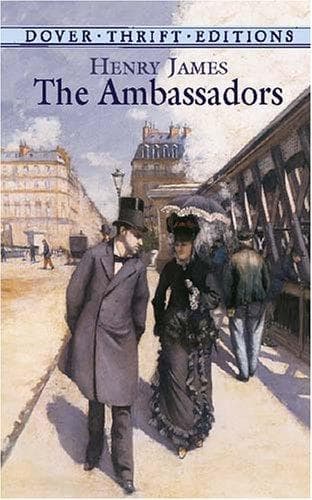
Americans -- France -- Fiction; Man-woman relationships -- Fiction; Paris (France) -- Fiction; Psychological fiction; Young men -- Fiction
“And quite properly. But not too proud for that.”
“It’s just her pride that has made her. Chad,” little Bilham loyally
went on, “has really been as kind to her as possible. It’s awkward for
a man when a girl’s in love with him.”
“Ah but she isn’t—now.”
Little Bilham sat staring before him; then he sprang up as if his
friend’s penetration, recurrent and insistent, made him really after
all too nervous. “No—she isn’t now. It isn’t in the least,” he went on,
“Chad’s fault. He’s really all right. I mean he would have been
willing. But she came over with ideas. Those she had got at home. They
had been her motive and support in joining her brother and his wife.
She was to _save_ our friend.”
“Ah like me, poor thing?” Strether also got to his feet.
“Exactly—she had a bad moment. It was very soon distinct to her, to
pull her up, to let her down, that, alas, he was, he _is_, saved.
There’s nothing left for her to do.”
“Not even to love him?”
“She would have loved him better as she originally believed him.”
Strether wondered. “Of course one asks one’s self what notion a little
girl forms, where a young man’s in question, of such a history and such
a state.”
“Well, this little girl saw them, no doubt, as obscure, but she saw
them practically as wrong. The wrong for her _was_ the obscure. Chad
turns out at any rate right and good and disconcerting, while what she
was all prepared for, primed and girded and wound up for, was to deal
with him as the general opposite.”
“Yet wasn’t her whole point”—Strether weighed it—“that he was to be,
that he _could_ be, made better, redeemed?”
Little Bilham fixed it all a moment, and then with a small headshake
that diffused a tenderness: “She’s too late. Too late for the miracle.”
“Yes”—his companion saw enough. “Still, if the worst fault of his
condition is that it may be all there for her to profit by—?”
“Oh she doesn’t want to ‘profit,’ in that flat way. She doesn’t want to
profit by another woman’s work—she wants the miracle to have been her
own miracle. _That’s_ what she’s too late for.”
Strether quite felt how it all fitted, yet there seemed one loose
piece. “I’m bound to say, you know, that she strikes one, on these
lines, as fastidious—what you call here _difficile_.”
Little Bilham tossed up his chin. “Of course she’s _difficile_—on any
lines! What else in the world _are_ our Mamies—the real, the right
ones?”
“I see, I see,” our friend repeated, charmed by the responsive wisdom
he had ended by so richly extracting. “Mamie is one of the real and the
right.”
“The very thing itself.”
“And what it comes to then,” Strether went on, “is that poor awful Chad
is simply too good for her.”
“Ah too good was what he was after all to be; but it was she herself,
and she herself only, who was to have made him so.”
It hung beautifully together, but with still a loose end. “Wouldn’t he
do for her even if he should after all break—”
Public-domain text, read in full here on John Shaqi.
Reviews
Reviews
No reviews yet
Be the first to share your thoughts on this work.
Elsewhere in the archive
Join the Discussion
Join the discussion
Sign in to leave a comment or review.
Sign InorCreate an account