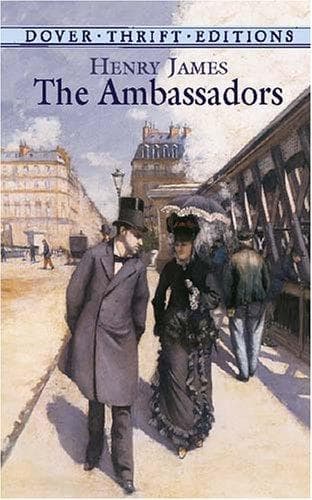
Americans -- France -- Fiction; Man-woman relationships -- Fiction; Paris (France) -- Fiction; Psychological fiction; Young men -- Fiction
She played her long handle, which shifted her observation; she saw in
an instant all the absences that left them free. “How can we be
anything else? But isn’t that exactly your plight? ‘We ladies’—oh we’re
nice, and you must be having enough of us! As one of us, you know, I
don’t pretend I’m crazy about us. But Miss Gostrey at least to-night
has left you alone, hasn’t she?” With which she again looked about as
if Maria might still lurk.
“Oh yes,” said Strether; “she’s only sitting up for me at home.” And
then as this elicited from his companion her gay “Oh, oh, oh!” he
explained that he meant sitting up in suspense and prayer. “We thought
it on the whole better she shouldn’t be present; and either way of
course it’s a terrible worry for her.” He abounded in the sense of his
appeal to the ladies, and they might take their choice of his doing so
from humility or from pride. “Yet she inclines to believe I shall come
out.”
“Oh I incline to believe too you’ll come out!”—Miss Barrace, with her
laugh, was not to be behind. “Only the question’s about _where_, isn’t
it? However,” she happily continued, “if it’s anywhere at all it must
be very far on, mustn’t it? To do us justice, I think, you know,” she
laughed, “we do, among us all, want you rather far on. Yes, yes,” she
repeated in her quick droll way; “we want you very, _very_ far on!”
After which she wished to know why he had thought it better Maria
shouldn’t be present.
“Oh,” he replied, “it was really her own idea. I should have wished it.
But she dreads responsibility.”
“And isn’t that a new thing for her?”
“To dread it? No doubt—no doubt. But her nerve has given way.”
Miss Barrace looked at him a moment. “She has too much at stake.” Then
less gravely: “Mine, luckily for me, holds out.”
“Luckily for me too”—Strether came back to that. “My own isn’t so firm,
_my_ appetite for responsibility isn’t so sharp, as that I haven’t felt
the very principle of this occasion to be ‘the more the merrier.’ If we
_are_ so merry it’s because Chad has understood so well.”
“He has understood amazingly,” said Miss Barrace.
“It’s wonderful—Strether anticipated for her.
“It’s wonderful!” she, to meet it, intensified; so that, face to face
over it, they largely and recklessly laughed. But she presently added:
“Oh I see the principle. If one didn’t one would be lost. But when once
one has got hold of it—”
“It’s as simple as twice two! From the moment he had to do something—”
“A crowd”—she took him straight up—“was the only thing? Rather, rather:
a rumpus of sound,” she laughed, “or nothing. Mrs. Pocock’s built in,
or built out—whichever you call it; she’s packed so tight she can’t
move. She’s in splendid isolation”—Miss Barrace embroidered the theme.
Strether followed, but scrupulous of justice. “Yet with every one in
the place successively introduced to her.”
“Wonderfully—but just so that it does build her out. She’s bricked up,
she’s buried alive!”
Public-domain text, read in full here on John Shaqi.
Reviews
Reviews
No reviews yet
Be the first to share your thoughts on this work.
Elsewhere in the archive
Join the Discussion
Join the discussion
Sign in to leave a comment or review.
Sign InorCreate an account