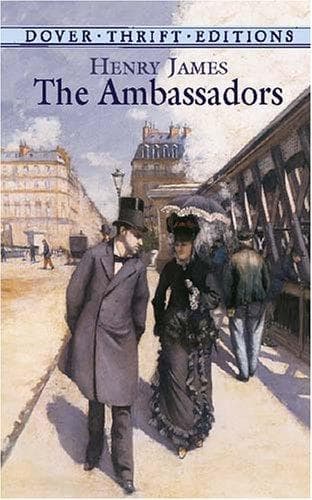
Americans -- France -- Fiction; Man-woman relationships -- Fiction; Paris (France) -- Fiction; Psychological fiction; Young men -- Fiction
Their eyes met on it with some intensity—during the few seconds of
which something happened quite out of proportion to the time. It
happened that Strether, looking thus at his friend, didn’t take his
answer for truth—and that something more again occurred in consequence
of _that_. Yes—Waymarsh just _did_ know about Mrs. Newsome’s cables: to
what other end than that had they dined together at Bignon’s? Strether
almost felt for the instant that it was to Mrs. Newsome herself the
dinner had been given; and, for that matter, quite felt how she must
have known about it and, as he might think, protected and consecrated
it. He had a quick blurred view of daily cables, questions, answers,
signals: clear enough was his vision of the expense that, when so wound
up, the lady at home was prepared to incur. Vivid not less was his
memory of what, during his long observation of her, some of her
attainments of that high pitch had cost her. Distinctly she was at the
highest now, and Waymarsh, who imagined himself an independent
performer, was really, forcing his fine old natural voice, an
overstrained accompanist. The whole reference of his errand seemed to
mark her for Strether as by this time consentingly familiar to him, and
nothing yet had so despoiled her of a special shade of consideration.
“You don’t know,” he asked, “whether Sarah has been directed from home
to try me on the matter of my also going to Switzerland?”
“I know,” said Waymarsh as manfully as possible, “nothing whatever
about her private affairs; though I believe her to be acting in
conformity with things that have my highest respect.” It was as manful
as possible, but it was still the false note—as it had to be to convey
so sorry a statement. He knew everything, Strether more and more felt,
that he thus disclaimed, and his little punishment was just in this
doom to a second fib. What falser position—given the man—could the most
vindictive mind impose? He ended by squeezing through a passage in
which three months before he would certainly have stuck fast. “Mrs
Pocock will probably be ready herself to answer any enquiry you may put
to her. But,” he continued, “_but_—!” He faltered on it.
“But what? Don’t put her too many?”
Waymarsh looked large, but the harm was done; he couldn’t, do what he
would, help looking rosy. “Don’t do anything you’ll be sorry for.”
Public-domain text, read in full here on John Shaqi.
Reviews
Reviews
No reviews yet
Be the first to share your thoughts on this work.
Elsewhere in the archive
Join the Discussion
Join the discussion
Sign in to leave a comment or review.
Sign InorCreate an account