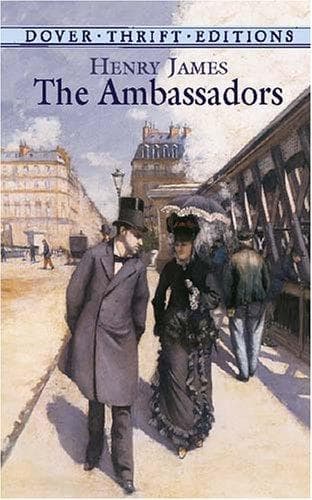
Americans -- France -- Fiction; Man-woman relationships -- Fiction; Paris (France) -- Fiction; Psychological fiction; Young men -- Fiction
It was an attenuation, Strether guessed, of something else that had
been on his lips; it was a sudden drop to directness, and was thereby
the voice of sincerity. He had fallen to the supplicating note, and
that immediately, for our friend, made a difference and reinstated him.
They were in communication as they had been, that first morning, in
Sarah’s salon and in her presence and Madame de Vionnet’s; and the same
recognition of a great good will was again, after all, possible. Only
the amount of response Waymarsh had then taken for granted was doubled,
decupled now. This came out when he presently said: “Of course I
needn’t assure you _I_ hope you’ll come with us.” Then it was that his
implications and expectations loomed up for Strether as almost
pathetically gross.
The latter patted his shoulder while he thanked him, giving the go-by
to the question of joining the Pococks; he expressed the joy he felt at
seeing him go forth again so brave and free, and he in fact almost took
leave of him on the spot. “I shall see you again of course before you
go; but I’m meanwhile much obliged to you for arranging so conveniently
for what you’ve told me. I shall walk up and down in the court
there—dear little old court which we’ve each bepaced so, this last
couple of months, to the tune of our flights and our drops, our
hesitations and our plunges: I shall hang about there, all impatience
and excitement, please let Sarah know, till she graciously presents
herself. Leave me with her without fear,” he laughed; “I assure you I
shan’t hurt her. I don’t think either she’ll hurt _me_: I’m in a
situation in which damage was some time ago discounted. Besides, _that_
isn’t what worries you—but don’t, don’t explain! We’re all right as we
are: which was the degree of success our adventure was pledged to for
each of us. We weren’t, it seemed, all right as we were before; and
we’ve got over the ground, all things considered, quickly. I hope
you’ll have a lovely time in the Alps.”
Waymarsh fairly looked up at him as from the foot of them. “I don’t
know as I _ought_ really to go.”
It was the conscience of Milrose in the very voice of Milrose, but, oh
it was feeble and flat! Strether suddenly felt quite ashamed for him;
he breathed a greater boldness. “_Let_ yourself, on the contrary, go—in
all agreeable directions. These are precious hours—at our age they
mayn’t recur. Don’t have it to say to yourself at Milrose, next winter,
that you hadn’t courage for them.” And then as his comrade queerly
stared: “Live up to Mrs. Pocock.”
“Live up to her?”
“You’re a great help to her.”
Waymarsh looked at it as at one of the uncomfortable things that were
certainly true and that it was yet ironical to say. “It’s more then
than you are.”
“That’s exactly your own chance and advantage. Besides,” said Strether,
“I do in my way contribute. I know what I’m about.”
Public-domain text, read in full here on John Shaqi.
Reviews
Reviews
No reviews yet
Be the first to share your thoughts on this work.
Elsewhere in the archive
Join the Discussion
Join the discussion
Sign in to leave a comment or review.
Sign InorCreate an account