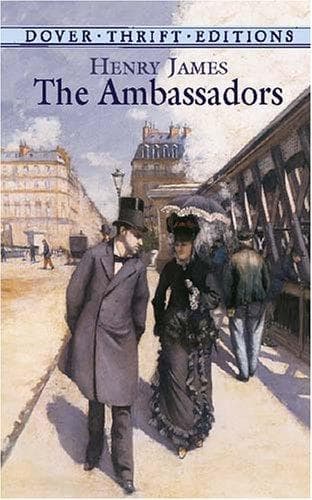
Americans -- France -- Fiction; Man-woman relationships -- Fiction; Paris (France) -- Fiction; Psychological fiction; Young men -- Fiction
flag; in the separate precautions she took not to show as nervous; in
the aggressive repose in which she did quite nothing but wait for him.
Doubt ceased to be possible from the moment he had taken in that she
had arrived with no proposal whatever; that her concern was simply to
show what she had come to receive. She had come to receive his
submission, and Waymarsh was to have made it plain to him that she
would expect nothing less. He saw fifty things, her host, at this
convenient stage; but one of those he most saw was that their anxious
friend hadn’t quite had the hand required of him. Waymarsh _had_,
however, uttered the request that she might find him mild, and while
hanging about the court before her arrival he had turned over with zeal
the different ways in which he could be so. The difficulty was that if
he was mild he wasn’t, for her purpose, conscious. If she wished him
conscious—as everything about her cried aloud that she did—she must
accordingly be at costs to make him so. Conscious he _was_, for
himself—but only of too many things; so she must choose the one she
required.
Practically, however, it at last got itself named, and when once that
had happened they were quite at the centre of their situation. One
thing had really done as well as another; when Strether had spoken of
Waymarsh’s leaving him, and that had necessarily brought on a reference
to Mrs. Pocock’s similar intention, the jump was but short to supreme
lucidity. Light became indeed after that so intense that Strether would
doubtless have but half made out, in the prodigious glare, by which of
the two the issue had been in fact precipitated. It was, in their
contracted quarters, as much there between them as if it had been
something suddenly spilled with a crash and a splash on the floor. The
form of his submission was to be an engagement to acquit himself within
the twenty-four hours. “He’ll go in a moment if you give him the
word—he assures me on his honour he’ll do that”: this came in its
order, out of its order, in respect to Chad, after the crash had
occurred. It came repeatedly during the time taken by Strether to feel
that he was even more fixed in his rigour than he had supposed—the time
he was not above adding to a little by telling her that such a way of
putting it on her brother’s part left him sufficiently surprised. She
wasn’t at all funny at last—she was really fine; and he felt easily
where she was strong—strong for herself. It hadn’t yet so come home to
him that she was nobly and appointedly officious. She was acting in
interests grander and clearer than that of her poor little personal,
poor little Parisian equilibrium, and all his consciousness of her
mother’s moral pressure profited by this proof of its sustaining force.
She would be held up; she would be strengthened; he needn’t in the
least be anxious for her. What would once more have been distinct to
him had he tried to make it so was that, as Mrs. Newsome was
Public-domain text, read in full here on John Shaqi.
Reviews
Reviews
No reviews yet
Be the first to share your thoughts on this work.
Elsewhere in the archive
Join the Discussion
Join the discussion
Sign in to leave a comment or review.
Sign InorCreate an account