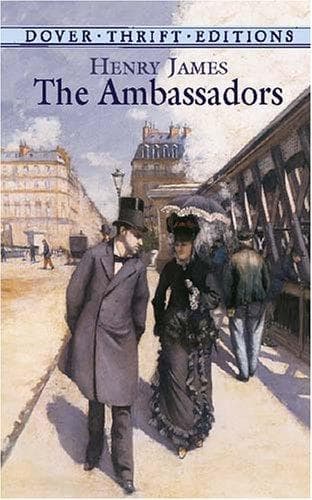
Americans -- France -- Fiction; Man-woman relationships -- Fiction; Paris (France) -- Fiction; Psychological fiction; Young men -- Fiction
Waymarsh had kept on his great panama, and, as he now stood nearer the
door, his last look beneath the shade of it had turned again to
darkness and warning. “So do I! See here, Strether.”
“I know what you’re going to say. ‘Quit this’?”
“Quit this!” But it lacked its old intensity; nothing of it remained;
it went out of the room with him.
III
Almost the first thing, strangely enough, that, about an hour later,
Strether found himself doing in Sarah’s presence was to remark
articulately on this failure, in their friend, of what had been
superficially his great distinction. It was as if—he alluded of course
to the grand manner—the dear man had sacrificed it to some other
advantage; which would be of course only for himself to measure. It
might be simply that he was physically so much more sound than on his
first coming out; this was all prosaic, comparatively cheerful and
vulgar. And fortunately, if one came to that, his improvement in health
was really itself grander than any manner it could be conceived as
having cost him. “You yourself alone, dear Sarah”—Strether took the
plunge—“have done him, it strikes me, in these three weeks, as much
good as all the rest of his time together.”
It was a plunge because somehow the range of reference was, in the
conditions, “funny,” and made funnier still by Sarah’s attitude, by the
turn the occasion had, with her appearance, so sensibly taken. Her
appearance was really indeed funnier than anything else—the spirit in
which he felt her to be there as soon as she was there, the shade of
obscurity that cleared up for him as soon as he was seated with her in
the small _salon de lecture_ that had, for the most part, in all the
weeks, witnessed the wane of his early vivacity of discussion with
Waymarsh. It was an immense thing, quite a tremendous thing, for her to
have come: this truth opened out to him in spite of his having already
arrived for himself at a fairly vivid view of it. He had done exactly
what he had given Waymarsh his word for—had walked and re-walked the
court while he awaited her advent; acquiring in this exercise an amount
of light that affected him at the time as flooding the scene. She had
decided upon the step in order to give him the benefit of a doubt, in
order to be able to say to her mother that she had, even to abjectness,
smoothed the way for him. The doubt had been as to whether he mightn’t
take her as not having smoothed it—and the admonition had possibly come
from Waymarsh’s more detached spirit. Waymarsh had at any rate,
certainly, thrown his weight into the scale—he had pointed to the
importance of depriving their friend of a grievance. She had done
justice to the plea, and it was to set herself right with a high ideal
that she actually sat there in her state. Her calculation was sharp in
the immobility with which she held her tall parasol-stick upright and
at arm’s length, quite as if she had struck the place to plant her
Public-domain text, read in full here on John Shaqi.
Reviews
Reviews
No reviews yet
Be the first to share your thoughts on this work.
Elsewhere in the archive
Join the Discussion
Join the discussion
Sign in to leave a comment or review.
Sign InorCreate an account