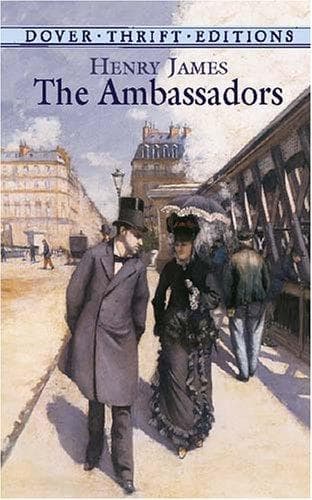
Americans -- France -- Fiction; Man-woman relationships -- Fiction; Paris (France) -- Fiction; Psychological fiction; Young men -- Fiction
“Yes, but things must have a basis.”
“A basis seemed to me just what her beauty supplied.”
“Her beauty of person?”
“Well, her beauty of everything. The impression she makes. She has such
variety and yet such harmony.”
She considered him with one of her deep returns of indulgence—returns
out of all proportion to the irritations they flooded over. “You’re
complete.”
“You’re always too personal,” he good-humouredly said; “but that’s
precisely how I wondered and wandered.”
“If you mean,” she went on, “that she was from the first for you the
most charming woman in the world, nothing’s more simple. Only that was
an odd foundation.”
“For what I reared on it?”
“For what you didn’t!”
“Well, it was all not a fixed quantity. And it had for me—it has
still—such elements of strangeness. Her greater age than his, her
different world, traditions, association; her other opportunities,
liabilities, standards.”
His friend listened with respect to his enumeration of these
disparities; then she disposed of them at a stroke. “Those things are
nothing when a woman’s hit. It’s very awful. She was hit.”
Strether, on his side, did justice to that plea. “Oh of course I saw
she was hit. That she was hit was what we were busy with; that she was
hit was our great affair. But somehow I couldn’t think of her as down
in the dust. And as put there by _our_ little Chad!”
“Yet wasn’t ‘your’ little Chad just your miracle?”
Strether admitted it. “Of course I moved among miracles. It was all
phantasmagoric. But the great fact was that so much of it was none of
my business—as I saw my business. It isn’t even now.”
His companion turned away on this, and it might well have been yet
again with the sharpness of a fear of how little his philosophy could
bring her personally. “I wish _she_ could hear you!”
“Mrs. Newsome?”
“No—not Mrs. Newsome; since I understand you that it doesn’t matter now
what Mrs. Newsome hears. Hasn’t she heard everything?”
“Practically—yes.” He had thought a moment, but he went on. “You wish
Madame de Vionnet could hear me?”
“Madame de Vionnet.” She had come back to him. “She thinks just the
contrary of what you say. That you distinctly judge her.”
He turned over the scene as the two women thus placed together for him
seemed to give it. “She might have known—!”
“Might have known you don’t?” Miss Gostrey asked as he let it drop.
“She was sure of it at first,” she pursued as he said nothing; “she
took it for granted, at least, as any woman in her position would. But
after that she changed her mind; she believed you believed—”
“Well?”—he was curious.
“Why in her sublimity. And that belief had remained with her, I make
out, till the accident of the other day opened your eyes. For that it
did,” said Maria, “open them—”
“She can’t help”—he had taken it up—“being aware? No,” he mused; “I
suppose she thinks of that even yet.”
Public-domain text, read in full here on John Shaqi.
Reviews
Reviews
No reviews yet
Be the first to share your thoughts on this work.
Elsewhere in the archive
Join the Discussion
Join the discussion
Sign in to leave a comment or review.
Sign InorCreate an account