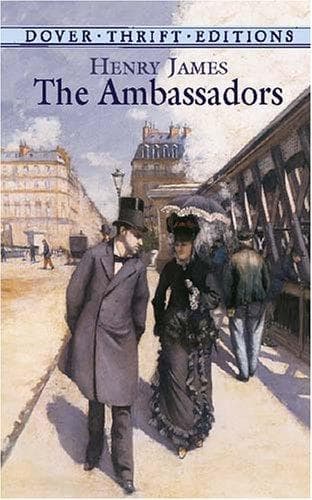
Americans -- France -- Fiction; Man-woman relationships -- Fiction; Paris (France) -- Fiction; Psychological fiction; Young men -- Fiction
“Then they _were_ closed? There you are! However, if you see her as the
most charming woman in the world it comes to the same thing. And if
you’d like me to tell her that you do still so see her—!” Miss Gostrey,
in short, offered herself for service to the end.
It was an offer he could temporarily entertain; but he decided. “She
knows perfectly how I see her.”
“Not favourably enough, she mentioned to me, to wish ever to see her
again. She told me you had taken a final leave of her. She says you’ve
done with her.”
“So I have.”
Maria had a pause; then she spoke as if for conscience. “She wouldn’t
have done with _you_. She feels she has lost you—yet that she might
have been better for you.”
“Oh she has been quite good enough!” Strether laughed.
“She thinks you and she might at any rate have been friends.”
“We might certainly. That’s just”—he continued to laugh—“why I’m
going.”
It was as if Maria could feel with this then at last that she had done
her best for each. But she had still an idea. “Shall I tell her that?”
“No. Tell her nothing.”
“Very well then.” To which in the next breath Miss Gostrey added: “Poor
dear thing!”
Her friend wondered; then with raised eyebrows: “Me?”
“Oh no. Marie de Vionnet.”
He accepted the correction, but he wondered still. “Are you so sorry
for her as that?”
It made her think a moment—made her even speak with a smile. But she
didn’t really retract. “I’m sorry for us all!”
IV
He was to delay no longer to re-establish communication with Chad, and
we have just seen that he had spoken to Miss Gostrey of this intention
on hearing from her of the young man’s absence. It was not moreover
only the assurance so given that prompted him; it was the need of
causing his conduct to square with another profession still—the motive
he had described to her as his sharpest for now getting away. If he was
to get away because of some of the relations involved in staying, the
cold attitude toward them might look pedantic in the light of lingering
on. He must do both things; he must see Chad, but he must go. The more
he thought of the former of these duties the more he felt himself make
a subject of insistence of the latter. They were alike intensely
present to him as he sat in front of a quiet little café into which he
had dropped on quitting Maria’s entresol. The rain that had spoiled his
evening with her was over; for it was still to him as if his evening
_had_ been spoiled—though it mightn’t have been wholly the rain. It was
late when he left the café, yet not too late; he couldn’t in any case
go straight to bed, and he would walk round by the Boulevard
Malesherbes—rather far round—on his way home. Present enough always was
the small circumstance that had originally pressed for him the spring
of so big a difference—the accident of little Bilham’s appearance on
the balcony of the mystic troisième at the moment of his first visit,
and the effect of it on his sense of what was then before him. He
Public-domain text, read in full here on John Shaqi.
Reviews
Reviews
No reviews yet
Be the first to share your thoughts on this work.
Elsewhere in the archive
Join the Discussion
Join the discussion
Sign in to leave a comment or review.
Sign InorCreate an account