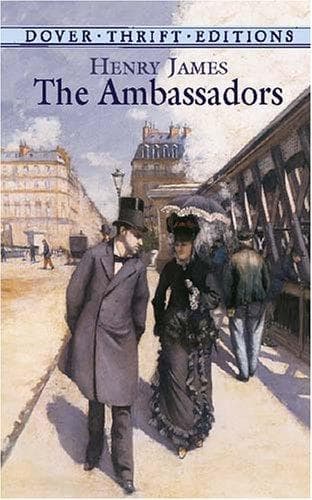
Americans -- France -- Fiction; Man-woman relationships -- Fiction; Paris (France) -- Fiction; Psychological fiction; Young men -- Fiction
railway-ticket—feeling, no doubt, older—the next day; but he had
meanwhile come up four flights, counting the entresol, at midnight and
without a lift, for Chad’s life. The young man, hearing him by this
time, and with Baptiste sent to rest, was already at the door; so that
Strether had before him in full visibility the cause in which he was
labouring and even, with the troisième fairly gained, panting a little.
Chad offered him, as always, a welcome in which the cordial and the
formal—so far as the formal was the respectful—handsomely met; and
after he had expressed a hope that he would let him put him up for the
night Strether was in full possession of the key, as it might have been
called, to what had lately happened. If he had just thought of himself
as old Chad was at sight of him thinking of him as older: he wanted to
put him up for the night just because he was ancient and weary. It
could never be said the tenant of these quarters wasn’t nice to him; a
tenant who, if he might indeed now keep him, was probably prepared to
work it all still more thoroughly. Our friend had in fact the
impression that with the minimum of encouragement Chad would propose to
keep him indefinitely; an impression in the lap of which one of his own
possibilities seemed to sit. Madame de Vionnet had wished him to
stay—so why didn’t that happily fit? He could enshrine himself for the
rest of his days in his young host’s _chambre d’ami_ and draw out these
days at his young host’s expense: there could scarce be greater logical
expression of the countenance he had been moved to give. There was
literally a minute—it was strange enough—during which he grasped the
idea that as he _was_ acting, as he could only act, he was
inconsistent. The sign that the inward forces he had obeyed really hung
together would be that—in default always of another career—he should
promote the good cause by mounting guard on it. These things, during
his first minutes, came and went; but they were after all practically
disposed of as soon as he had mentioned his errand. He had come to say
good-bye—yet that was only a part; so that from the moment Chad
accepted his farewell the question of a more ideal affirmation gave way
to something else. He proceeded with the rest of his business. “You’ll
be a brute, you know—you’ll be guilty of the last infamy—if you ever
forsake her.”
Public-domain text, read in full here on John Shaqi.
Reviews
Reviews
No reviews yet
Be the first to share your thoughts on this work.
Elsewhere in the archive
Join the Discussion
Join the discussion
Sign in to leave a comment or review.
Sign InorCreate an account