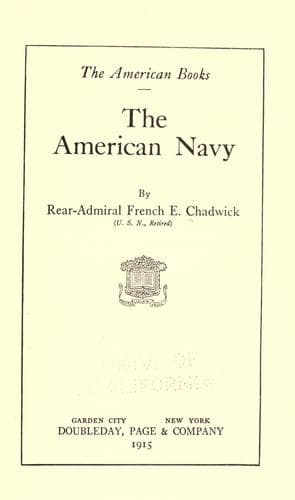
United States -- History, Naval; United States. Navy -- History
The end of the “Brothers’ War” had made of the United States a nation.
Our country took its place in the world, and its fleets again reached
into every sea. But the lessons of the navy had not touched the dull
minds which in June, 1860, had voted down the supplies of the little
navy which was to expand so greatly in the four succeeding years. To
such, the whole work of defeating the Confederacy appeared to be the
more spectacular work of the army. The constriction of the blockade
was not of the dramatic character of Gettysburg or the battles of
the Wilderness. Its meaning was to filter but slowly into even the
more thoughtful. Thus for years, while immense changes were going on
elsewhere, we were at a standstill in naval matters, or rather slowly
sinking to absolute nonentity. By 1882 the shameful condition of
neglect began to be remedied. That year may be taken as the birth-year
of our navy of to-day. For seven years we had to go abroad for such
material--gun-forgings, shafting, and armor--as we wanted, until our
naval demands forced upon our steel establishments the work of putting
themselves in order. The story of this work has never been told, but
the country can be assured that it was to the navy that the initial
great development of steel manufacture in this country was due. In 1882
we could make only a forged iron shaft for the little _Dolphin_, which
promptly broke on her trial trip. It was through arrangements made by
the Navy Department that our steel works, beginning with Bethlehem,
established modern conditions.
The story of the building of the new navy is outside the scope of
this book. It suffices to say that by 1898 we had in service four
battleships, the _Iowa_, _Indiana_, _Oregon_, and _Massachusetts_, of
the first class; the _Texas_, of the second; two armored cruisers, the
_New York_ and _Brooklyn_; eleven protected cruisers of from 3,000 to
7,735 tons, and twenty unprotected cruisers of from 839 to 2,089 tons.
We also had eight torpedo boats, a dynamite vessel, the _Vesuvius_, and
six ships of the monitor type, from 4,000 to 6,060 tons. It was with
this fleet we fought the war with Spain.
The causes of this war stretch back through generations. Their
foundation was, essentially, a difference in race. The American is
mainly an Anglo-Saxon, direct and practical in his way; the Spaniard an
oriental, courteous, kindly in the relations of friendship and family,
with much that is lovable, but impracticable, tribal in his tendencies,
knowing little of the modern phases of government by a constitution,
and bloodthirsty and devastating in putting down revolt or in settling
political differences. An anarchic century in Spain produced like
conditions in Cuba. Our proximity to Cuba and our many commercial
interests there were very strong elements in the situation.
Public-domain text, read in full here on John Shaqi.
Reviews
Reviews
No reviews yet
Be the first to share your thoughts on this work.
Elsewhere in the archive
Join the Discussion
Join the discussion
Sign in to leave a comment or review.
Sign InorCreate an account