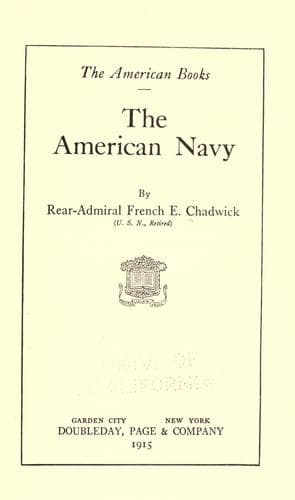
United States -- History, Naval; United States. Navy -- History
A great impetus was given to feeling for Cuba and against Spain by the
explosion of the _Maine_ in Havana Harbor about 9:30 P.M., February
15th. Two months, however, were yet to pass before war was declared,
though at the last moment Spain had acceded to all our demands. While
our diplomacy may thus be said to have been not entirely “correct,”
President McKinley may be ruled to have been wise in cutting the
Gordian knot by war, which his message of April 11, 1898, practically
did in referring the whole subject to Congress. The joint resolution
passed and signed on April 20th, demanding that Spain should
relinquish her authority in Cuba, was of course taken as a declaration
of war by Spain, and April 21st was declared by Congress a few days
later as the official date of its beginning.
On the afternoon of May 21st Captain William T. Sampson, who was now
in command of the North Atlantic station, and was with the flagship
_New York_ off the reef at Key West where well-nigh all the available
ships in the Atlantic were collected, received a telegram announcing
his assignment to the command, with the rank of rear-admiral, an
advancement only possible by selection by the President in time of
war. This was the first indication of actual hostilities, but it was
soon followed by another ordering to blockade immediately the coast of
Cuba from Cardenas to Bahia Honda (a little west of Havana). Gathering
during the night outside the reef (distant six miles from Key West) all
the ships ready to move, the fleet early next morning was on its way,
and by evening was off Havana, the searchlights of which were sweeping
the sea in expectancy of the American fleet. Powerfully armed as were
its batteries, they were, curiously enough, so disposed that they
were open to attack from the southwest, with little possibility of
return. It was Sampson’s eager wish to make this attack at once, and a
battle-order had been drawn in anticipation of war, early in April, but
the Navy Department in a letter of April 6th set its face so decidedly
against the attempt, that Sampson had to yield. The department from
the view of the necessity of preserving the fleet to meet Cervera was
justified, but Sampson’s view, as later analysis of the situation
showed, was correct. Had action been allowed, Havana would have been
ours, without loss, on April 23d.
In addition to Sampson’s command, a squadron made up of the _Brooklyn_,
_Massachusetts_, and _Texas_ was stationed at Hampton Roads under
Commodore Schley; and several others, among them the fast _Columbia_
and _Minneapolis_ and the cruiser _San Francisco_, were kept north to
meet the clamor of the seacoast in general for protection. The public
could not understand that the only real protection was concentration
against, and the destruction of, the enemy’s fleet.
Public-domain text, read in full here on John Shaqi.
Reviews
Reviews
No reviews yet
Be the first to share your thoughts on this work.
Elsewhere in the archive
Join the Discussion
Join the discussion
Sign in to leave a comment or review.
Sign InorCreate an account