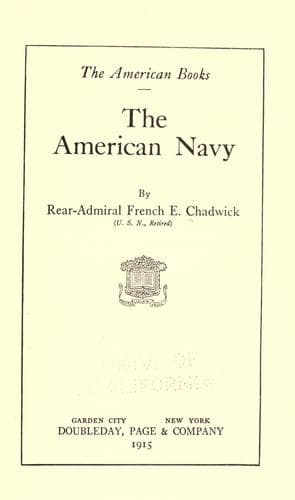
United States -- History, Naval; United States. Navy -- History
When Great Britain attempted to reduce to obedience the rebellious
colonies which were to form the United States of America she was
dealing with a people who in the North at least had long been
conversant with the building and sailing of ships. A New England built
ship entered the Thames in 1638, only eighteen years after the landing
of the Pilgrims at Plymouth, Massachusetts. The New England men, with a
sterile coast, with limitless fishing grounds and unsurpassed harbors,
turned as naturally to the sea for livelihood as did the South, more
kindly treated by nature, to agriculture. In 1670 it was estimated
that two thirds of the British shipping was employed in the American
trade. The Dutch, who had been great carriers on the sea, were excluded
from this trade by the navigation laws of the period. Scotland was not
admitted to the trade of the American plantations until her union with
England in 1707, and Ireland not until 1780, while in 1670 nothing
could be imported into the American colonies but what was laden in
England in English-built ships. But while none of their products could
be carried anywhere (except to other of the plantations) till they were
first landed in England, the ships built in America were reckoned as
English, and this fact gave great impetus to American shipbuilding.
American shipping prospered amazingly. But while thus prospering, it
was the attempted repression of our commerce afloat and ashore (which
included such things as forbidding the exportation of hats, restricting
the manufacture of iron, and forbidding commerce with the foreign-owned
islands of the West Indies) which did much more to develop the idea of
independence than did the Stamp Act. But the net result of conditions
was to foster shipping, and our competition had so increased by 1725
that in that year “the shipwrights of the river Thames came up to
Whitehall with a complaint that their business had declined and their
workmen emigrated because the plantations furnished England with ships.”
On the register of the underwriters at Lloyd’s for 1775, comprehending
the shipping of the three preceding years, there were 3,908
British-built vessels of 605,545 tons, and 2,311 of American build
with a tonnage of 373,618 tons. The average size of the ship of the
time was about 400 tons displacement. One 100 feet in length and 26
to 28 feet broad was a good-sized ship. They were but cockle boats in
comparison with the vast ships of to-day, many of which are full a
hundred times 400 tons displacement.
The foregoing will show that when there came a time to dispute the sea
with Great Britain there was no difficulty in supplying the ships,
and the many ironworks which had been established, particularly in
Massachusetts and Pennsylvania, despite Great Britain’s restrictions,
could furnish guns in the manufacture of which our foundries were
adepts before the war.
Public-domain text, read in full here on John Shaqi.
Reviews
Reviews
No reviews yet
Be the first to share your thoughts on this work.
Join the Discussion
Join the discussion
Sign in to leave a comment or review.
Sign InorCreate an account