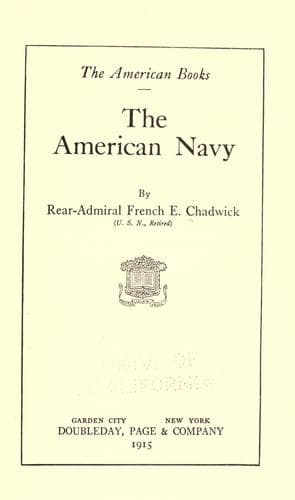
United States -- History, Naval; United States. Navy -- History
In September, 1744, there met at Philadelphia, then our foremost
city, representatives of each of the thirteen colonies, called
together on account of the increasing difficulties which had arisen
with the mother country. These difficulties arose mainly from the
tendency of parliament to govern the colonies as it would, say,
any county of England. This right the Americans denied. They were
good subjects of the King, but they objected to parliamentary rule.
The underlying idea which governed the action of the Americans was
thus that of a federalism which only in these latter days has laid
hold in any considerable degree of the minds of the English, who
now debate the possibility of England, Scotland, Wales, Ireland,
Canada, Australia, New Zealand, and South Africa becoming states of a
federation somewhat akin to our own. But at the time of the outbreak
of our Revolution there was no widespread idea of separation. It
was, however, in the air, and by some openly advocated. Had there
been a complete renouncement of the right of parliament to make laws
governing the colonies there would, for the time at least, have been
a reconciliation. It was upon this principle we divided. Thus the war
began.
There was at this time on our coast a British naval force of four ships
of from seventy to fifty guns (these at Boston), and twenty from twenty
to six guns distributed from New Hampshire to Florida. The whole was a
very moderate force considering the long-standing discontent and the
difficulties of the existing situation. The British navy, in which, as
in the administration of every other department of the British public
service of the period, inefficiency and dishonesty reigned to an almost
unbelievable degree, had been allowed to run down sadly after the Seven
Years’ War which ended in 1763. The total number of ships was but 270
and the number of seamen but 18,000. Before the war closed the ships
were to number 468, of which 174 were ships-of-the-line (carrying from
sixty to one hundred guns), and the seamen were to number 110,000.
The situation of the United States was much akin to that of the
Southern Confederacy. Its resources were too meagre to carry on a war
without the importation of much that was necessary to keep an army in
efficiency. Thus the true plan of England was a strict blockade and the
reduction to inanition of our forces, such as we ourselves carried on
against the South in our Civil War. This action was advocated strongly
by Viscount Barrington, the Secretary for War, who urged that the navy
only should be employed, and that the ships should take possession of
all our ports and establish a complete blockade. Fortunately for the
revolutionists, his advice was not heeded.
Public-domain text, read in full here on John Shaqi.
Reviews
Reviews
No reviews yet
Be the first to share your thoughts on this work.
Join the Discussion
Join the discussion
Sign in to leave a comment or review.
Sign InorCreate an account