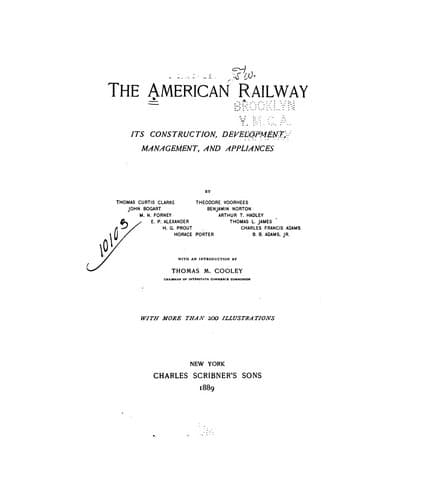
The American Railway: Its Construction, Development, Management, and AppliancesClarke, Thomas Curtis
History
The American Railway: Its Construction, Development, Management, and Appliances
Clarke, Thomas Curtis
Railroads -- United States
These principles, duly observed, will prevent collisions, but
they will often cause trains to lose a great deal of time. The
train-despatcher, therefore, has authority to handle extra and
delayed trains by direct telegraphic order. Every possible
precaution is taken to insure that such orders are received and
correctly understood. As there are great advantages following
uniformity of usages and rules among connecting roads, after
years of conference, in conventions and by committees, approved
forms of all running rules and signals have recently been adopted
and are now in very general use over the United States. Yet,
in spite of all possible precautions, accidents will sometimes
happen. Richard Grant White gave a name to a mental habit which,
in train-despatchers, has caused many fatal accidents. It is
"heterophemy," or thinking one thing while saying, hearing, or
reading another. A case within my knowledge, which cost a dozen
lives, was as follows: Two opposing trains were out of time,
and the train-despatcher wished to have them meet and pass at a
certain station we will call "I," as Nos. 1 and 2 are represented
as doing on the diagram (see diagram of schedule board, p. 161).
So he telegraphed the following message, to be delivered to No. 1
at "H" and to No. 2 at "J": "Nos. 1 and 2 will meet at 'I.'"
This message was correctly received at "J" and delivered to No.
2. But at "H" the operator had just sold a passenger a ticket to
"K," and, getting this name in his head, he wrote out the message:
"Nos. 1 and 2 will meet at 'K.'" But the mistake was not yet
past correction. The operator had to repeat the message back to
the despatcher, that the latter might be sure it was correctly
understood. He repeated it as he had written it--"K." But the
despatcher was also "heterophemous." He _saw_ "K," but he _thought_
"I," and replied to the operator that the message was O. K.
[Illustration: Entrance Gates at a Large Station.]
So it was delivered to No. 1, and that train left "H" at full
speed, expecting to run thirty-five miles to "K" before meeting
No. 2. There was no telegraph office at "I," and there were no
passengers to get off or on, and it passed there without stopping,
and three miles below ran into No. 2 on a curve.
By one of those strange impulses which seem to come from some
unconscious cerebration, the train-despatcher meanwhile had a
feeling that something was wrong, and looked again at the message
received from "H" and discovered his mistake. But the trains were
then out of reach. He still hoped that No. 2 might arrive at "I"
first, or that they might meet upon a straight portion of road,
and as the time passed he waited at the instrument in a state of
suspense which may be imagined. When the news came he left the
office, and never returned.
Public-domain text, read in full here on John Shaqi.
Reviews
Reviews
No reviews yet
Be the first to share your thoughts on this work.
Elsewhere in the archive
Join the Discussion
Join the discussion
Sign in to leave a comment or review.
Sign InorCreate an account