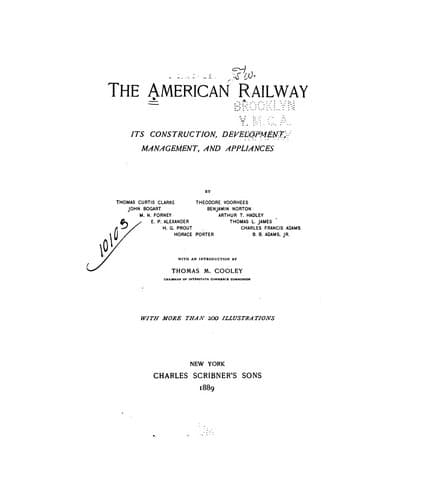
The American Railway: Its Construction, Development, Management, and AppliancesClarke, Thomas Curtis
History
The American Railway: Its Construction, Development, Management, and Appliances
Clarke, Thomas Curtis
Railroads -- United States
But the more usual way of handling extra trains, when circumstances
will permit, is to let them precede or follow a regular train upon
the same schedule. The train is then said to be run in "sections,"
and a ten minutes' interval is allowed between them. That opposing
trains may be informed, the leading section (and when there are
more than two all but the last) wears on its locomotive two green
flags by day and two green lights by night, indicating that a train
follows which is to be considered as a part of the train leading,
and having the same rights.
[Illustration: A lamp swung vertically in a circle across the
track, when the train is standing, is the signal to move back.]
So far the rules are very simple, and they would be all that is
necessary if all trains could always be kept exactly on time. But
as that cannot be, provision must be made for all the complications
which will result. The first and most important rule is that no
train must ever, under any circumstances, run _ahead_ of time.
The next is that any train making a stop not on its schedule must
immediately send out flagmen with red flags, lights, and torpedoes
to protect it. This rule is a very difficult one to enforce
without rigid discipline, and its neglect is the cause of a large
percentage of the accidents "that will happen." The flagman who
must go to the rear, often a half-mile, at night, across trestles
and in storms, must frequently be left behind, to take his chances
of getting home by being picked up by a following train. There is
no one to watch him, and he will often take chances, and not go as
far back or as fast as he should; and if all goes well no one is
ever the wiser.
[Illustration: A lamp swung vertically in a circle at arm's length
across the track, when the train is running, is the signal that the
train has parted.]
Now, when a train is prevented from arriving on time at its
meeting-point, we must have some rules by which the opposing train
may proceed, or all business on the road would be suspended by the
delay of a single train. Only the general principles of these rules
can be stated within limits. They are as follows:
1. All freight trains must wait indefinitely for all passenger
trains.
2. When one train only is behind time, the opposing train of the
same class will wait for it a specified time, usually ten minutes,
and five minutes more for possible variation of watches, then go
ahead, keeping fifteen minutes behind its schedule.
3. But should such a train, running on delayed time, lose more
time, or in any other way should both trains get behind time,
then the one which is bound in a certain direction--for instance,
north--has the right to the track, and the other must lie by
indefinitely.
[Illustration: The General Despatcher.]
Public-domain text, read in full here on John Shaqi.
Reviews
Reviews
No reviews yet
Be the first to share your thoughts on this work.
Elsewhere in the archive
Join the Discussion
Join the discussion
Sign in to leave a comment or review.
Sign InorCreate an account