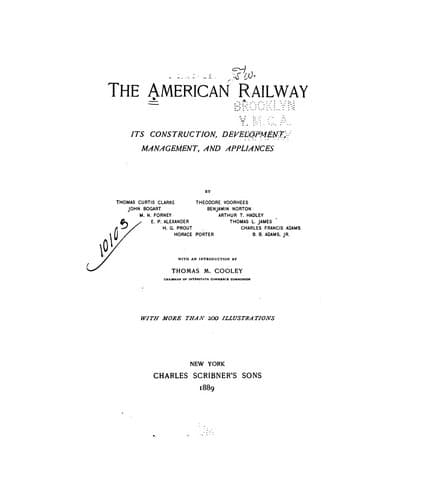
The American Railway: Its Construction, Development, Management, and AppliancesClarke, Thomas Curtis
History
The American Railway: Its Construction, Development, Management, and Appliances
Clarke, Thomas Curtis
Railroads -- United States
It has been suggested that a great step in advance would be to
have all the roads in the United States unite and put all cars
into a common stock and let them be distributed, record kept of
movements, and mileage paid through a general clearing house.
This would practically form a single rolling-stock company owned
by the roads contributing their cars to it. It could gradually
introduce uniform patterns of construction, improved couplers, and
air-brakes, and could concentrate cars in different sections of the
country in large numbers as different crops required movement, thus
avoiding the blockades which often occur in one section while cars
are superabundant in another. Consolidations usually render more
efficient and cheaper service than separate organizations can do,
and this may come about in the course of time.[18]
We have now seen how the road is maintained and its trains safely
handled. The next step in order is to see how business is secured
and the rates to be charged are fixed. This department may be
controlled by a traffic manager, with two assistants--the general
freight agent and the general passenger agent--or the officers may
report directly to the general manager without the intervention
of a traffic manager. But it would be a more accurate expression
to say, not that these officers "fix" the rates, for if they did
few railroads would ever fail, but that they accept and announce
the rates that are fixed by conditions of competition between
different markets and products, and between different railroads
and water lines. Among these complex forces a railroad freight
agent is nearly as powerless to regulate rates as a professor of
grammar is to regulate the irregularities of English verbs. He
can accept them and use them, or he may let them alone, but the
irregularities will remain, all the same. There is no eccentricity,
for example, more idiotic or indefensible to the ordinary citizen
than a habit railroads have of sometimes charging less money for
a long haul than they charge for a shorter haul. Yet I believe
there is not a railroad line in the United States which will not
be found guilty of this apparent folly of charging "less for
the long haul" if its rates to distant points are followed far
enough. For if followed far enough we shall come to the ocean,
and find the railroad accepting business between two seaports. For
instance, all railroads running westward from New York through
some of their connections finally reach San Francisco, and compete
for freight between these ports. But the rates they are able to
obtain are limited by steamers using the ocean for a highway,
and sailing vessels using the wind for motive power, and able to
carry heavy freights at one-tenth the average cost to railroads
across mountains and deserts. This average cost must fix the
average rates charged by the railroads to intermediate points,
such as to Ogden, in Utah. So the railroad must either charge less
Public-domain text, read in full here on John Shaqi.
Reviews
Reviews
No reviews yet
Be the first to share your thoughts on this work.
Elsewhere in the archive
Join the Discussion
Join the discussion
Sign in to leave a comment or review.
Sign InorCreate an account