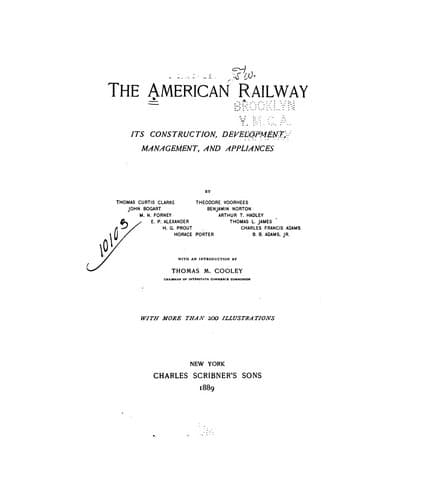
The American Railway: Its Construction, Development, Management, and AppliancesClarke, Thomas Curtis
History
The American Railway: Its Construction, Development, Management, and Appliances
Clarke, Thomas Curtis
Railroads -- United States
for the long haul to San Francisco, or leave that business to be
done solely by water. Yet it may be profitable to the railroad to
accept the business at such rates as it can obtain; for, as in all
business ventures, manufacturing or mercantile, _new_ business
can be profitably added at less than the average cost. And if
profitable to the railroad its tendency is beneficial, even to the
intermediate points which pay higher rates, as promoting better
service, besides being advantageous to the whole Pacific Coast in
tending to keep down the rates by water.
But it would lead too far from our subject to follow this and
several other questions which are suggested by it. Only it may
be said briefly that the original Interstate Commerce Bill,
introduced by Mr. Reagan, absolutely prohibited "less for the long
haul." The Senate amended by adding "under similar circumstances
and conditions," and the Interstate Commerce Commission has held
that "water competition" makes dissimilar circumstances and thus
legalizes it.
And in this connection it may be added that the other Senate
amendment to the Reagan bill, creating an Interstate Commerce
Commission, was, next to the above amendment, the wisest measure
of the bill. It forms a body of experts whose opinions and
decisions must gradually educate the public, on the one hand, to
a better understanding of transportation problems, and restrain
the railroads, on the other, from many of the abuses incident
to unchecked competition among them. For, however theorists may
differ as to the advantages or disadvantages of competition
in manufactures and commerce, either absolutely unchecked or
checked only by high or low tariffs, I think all will agree that
unchecked _railroad_ competition is a great evil, because it
results in fluctuating rates and private rebates to large shippers.
The rebates, to be sure, are forbidden by law, but they can be
disguised past recognition. I have known a case, for instance,
where a receipt was given for 75 barrels of whiskey, when only
73 were shipped. The shipper was to make claim for two barrels
lost and be paid an agreed value as a rebate on his freight bill.
In another case, a road agreed with a certain shipper to pay his
telegraph bills for a certain period in order to control his
shipments. Understating the weight or class of the shipment is
another common device for undercharging or rebating.
Public-domain text, read in full here on John Shaqi.
Reviews
Reviews
No reviews yet
Be the first to share your thoughts on this work.
Elsewhere in the archive
Join the Discussion
Join the discussion
Sign in to leave a comment or review.
Sign InorCreate an account