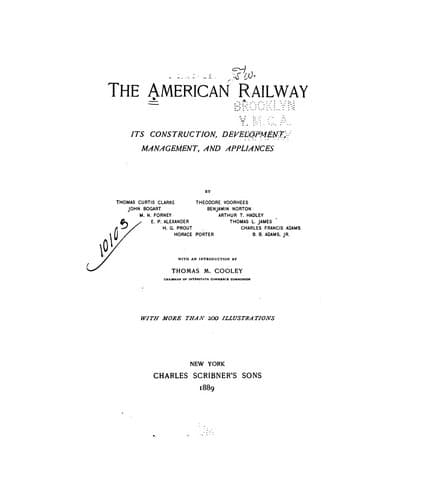
The American Railway: Its Construction, Development, Management, and AppliancesClarke, Thomas Curtis
History
The American Railway: Its Construction, Development, Management, and Appliances
Clarke, Thomas Curtis
Railroads -- United States
In nearly every foreign country there is either a railroad pool or
a division of territory, to prevent this sort of competition, which
is only pernicious. A merchant needs to feel assured that rates are
stable and uniform to all, and not that he must go shopping for
secret rates, in order to be on an equality with his competitor.
In the United States the railroads had largely resorted to pools
before the Interstate Commerce Law forbade them. The result of
this prohibition has generally been very advantageous to the best
lines, which, under the pool, really paid a sort of blackmail to
the poorer lines to maintain rates. If the penalties of the law
can restrain such lines from rebating and under-billing, to be rid
of the pool will be a great blessing to the well-located roads. If
not, then the roads will be driven into consolidation, for the end
of fighting will be bankruptcy and sale. Fortunately consolidation
has already gone so far in many sections of the country that the
difficulties of abolishing rebates have been greatly reduced. And
as far as it has gone it has proved of much advantage both to the
public and to the stockholders.
Fortunately, too, the other results attendant upon consolidation
have been sufficiently demonstrated to remove any intelligent
fear of extortion in rates or deterioration of service. Who would
to-day desire to undo the consolidations which have built up the
Pennsylvania Railroad or the New York Central, and call back to
life the numberless small companies which preceded them? The
country has outgrown such service as they could render, and the
local growth and development along the lines of these consolidated
companies certainly indicates improved conditions. In this
connection, too, the improvement in cost and character of service
is instructive. In 1865 the average rate per ton per mile on the
principal Eastern lines was about 2.900 cents; in 1887 it was 0.718
for a service twice as speedy and efficient.
There are many other live issues of great interest and importance
in transportation suggested by this subject, such as "re-billing"
or "milling in transit," and "differentials," but space forbids
more than an explanation of the meaning of these two especially
prominent ones.
A B C
-----------------------------
Public-domain text, read in full here on John Shaqi.
Reviews
Reviews
No reviews yet
Be the first to share your thoughts on this work.
Elsewhere in the archive
Join the Discussion
Join the discussion
Sign in to leave a comment or review.
Sign InorCreate an account