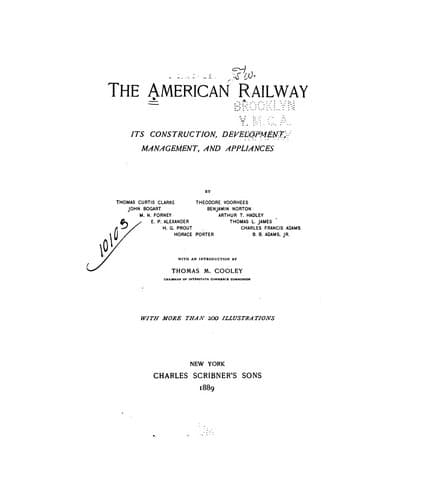
The American Railway: Its Construction, Development, Management, and AppliancesClarke, Thomas Curtis
History
The American Railway: Its Construction, Development, Management, and Appliances
Clarke, Thomas Curtis
Railroads -- United States
The road A B has two connections, C and D, to reach E. It sells
tickets over each at the same rate, and stands neutral between
them. But C agrees with A's ticket-seller that he will give him a
dollar for every ticket he can sell over C's line. D finds that
he is losing travel, and offers, privately, a larger commission.
Neither knows what the other is doing. The ticket-seller gets his
regular salary from A, and from C and D often enormous sums as
commissions, and is interested, not in sending ignorant travellers
over the line which might suit them best, but over the one paying
him the largest secret commission. This should be held as against
public policy, because it tends to prevent reductions in rates
to the public by robbing the roads of much of their revenue, and
it also demoralizes the officers who handle a business which is
practically but the giving away of large sums of money as bribes.
There is another practice in the passenger business which is unfair
at the best and is the source of many abuses. It is charging the
same to the man with no baggage as to the man with a Saratoga
trunk. If the baggage service were specially organized as a trunk
express, it could be more efficiently handled and without any
"baggage smashing," while the total cost of travelling to persons
with baggage would be no more than at present, and to those
without, much less.
As an illustration of the sort of abuses to which it is now liable,
I may cite a single case. I have known a merchant buy a lot of
twenty trunks for his trade, pack them all full of dry-goods,
check them to a city 1,000 miles away by giving a few dollars to
baggage-men, and himself buy a single ticket and go by a different
route. The roads which handled that baggage imagined that it
belonged to their passengers, and were never the wiser. While
the baggage service is free, no efficient checks can be provided
against such frauds.
Essential parts of both freight and passenger departments are the
soliciting agents. They are like the cavalry pickets and scouts of
an army, scattered far and wide over the country and looking after
the interests of their lines, making personal acquaintances of all
shippers and travellers, advertising in every possible manner,
and reporting constantly all that the enemy--the rival lines--are
doing, and often a great deal that they are not. For the great
railroad wars usually begin in local skirmishes brought on by the
zeal of these pickets when the officers in command would greatly
prefer to live in peace.
Public-domain text, read in full here on John Shaqi.
Reviews
Reviews
No reviews yet
Be the first to share your thoughts on this work.
Elsewhere in the archive
Join the Discussion
Join the discussion
Sign in to leave a comment or review.
Sign InorCreate an account