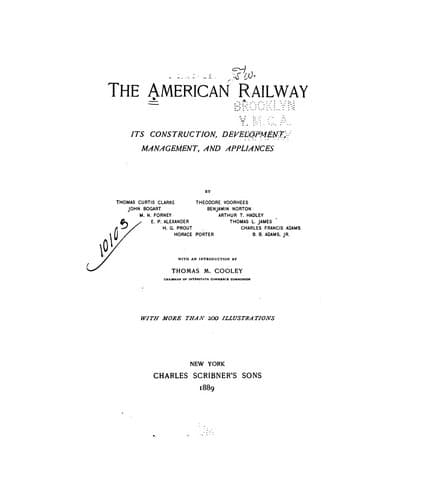
The American Railway: Its Construction, Development, Management, and AppliancesClarke, Thomas Curtis
History
The American Railway: Its Construction, Development, Management, and Appliances
Clarke, Thomas Curtis
Railroads -- United States
Besides their receipts from freight and passenger traffic,
railroads derive revenue also from the transportation of mails
and express freight on passenger trains, from the sleeping-car
companies, and from news companies for the privilege of selling
upon trains. Of the total revenue about 70 per cent. is usually
derived from freight, 25 per cent. from passengers, and 5 per cent.
from mail, express, sleeping-cars, and privileges. When it is
considered that high speed involves great risks and necessitates
a far more perfect roadway, more costly machinery and appliances,
and a higher grade and a greater number of employees, the fast
passenger, mail, and express traffic hardly seems at present to
yield its due proportion of income.
* * * * *
We have now followed the line of organization and management
through the physical maintenance of the road and rolling stock,
the safe handling of the trains, the establishment of rates, and
solicitation of business. It only remains to show how the revenue
is collected, how the expenses of operation are paid, and all
statistics of the business prepared. These duties are usually
united under charge of an officer called the comptroller, general
auditor, or some equivalent title. His principal subordinates,
whose duties are indicated by their titles, are the auditor of
receipts, auditor of disbursements, local treasurer, paymaster, and
clerk of statistics.
The record of a single shipment of freight will illustrate methods,
so far as limits will permit. A shipper sending freight for
shipment sends with each dray-load a "dray ticket" in duplicate,
showing the articles, weight, marks, and destination. If he has
prepaid the freight, or advanced any charges which are to be
paid at destination, it is also noted on the dray ticket. When
the drayman reaches the outbound freight depot with his load,
he is directed to a certain spot where all freight for the same
destination is being collected for loading. A receiving clerk
checks off his load against the duplicate dray tickets, keeps one
and files it, and gives the drayman the other, receipted. In case
of any loss arising afterward, the original dray ticket, made by
the shipper himself, with his marks and instructions, becomes a
valuable record. When the entire shipment has been delivered at
the loading point, the shipper takes the dray tickets representing
it to the proper desk, and receives "a bill of lading." This bill
of lading is made in triplicate. The original and a duplicate
are given to the shipper. He keeps the last and sends the former
to the consignee. It represents the obligation of the railroad
to transport and deliver the articles named on it to the person
named, or his assignee. It is negotiable, and banks advance money
upon it. But the shipper may still, by a legal process, have the
goods stopped _en route_ should occasion arise, as, for instance,
by the bankruptcy of the consignee. The goods are also liable for
Public-domain text, read in full here on John Shaqi.
Reviews
Reviews
No reviews yet
Be the first to share your thoughts on this work.
Elsewhere in the archive
Join the Discussion
Join the discussion
Sign in to leave a comment or review.
Sign InorCreate an account