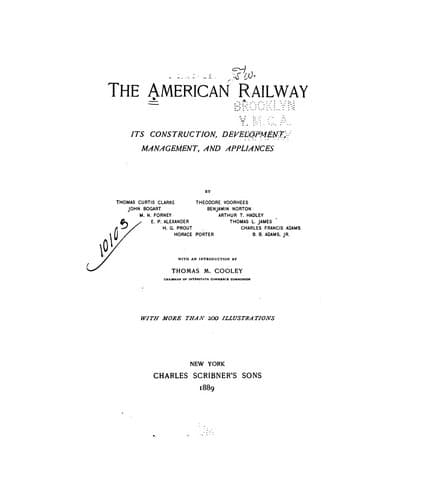
The American Railway: Its Construction, Development, Management, and AppliancesClarke, Thomas Curtis
History
The American Railway: Its Construction, Development, Management, and Appliances
Clarke, Thomas Curtis
Railroads -- United States
| of Road---{ Walkers
| {Wood and Water
| { Tenders
| {Floating Gangs
| {Construction
| { Trains
+Car Accountant-------Lost Car Agents
|
| +-General {Travelling Agents
| | Passenger Agent---{Local Agents
| | {Rate and Division Clerks
+Traffic Manager----+-Claim Agent
|
+-General {Travelling Agents
Freight Agent-----{Local Agents
{Rate and Division Clerks
Diagram showing the Skeleton of a Railroad Organization, and Lines of
Responsibility.
In Europe, where the pooling system practically prevails, the
service is much more stable than in the United States, and in many
instances there are pensions and insurances and disability funds,
and regular rules for promotion and retirement, and provision for
the children of employees being brought into service in preference
to outsiders. Such relations between a company and its employees as
must result from arrangements of this character are surely of great
benefit to both. They are the natural outgrowth of _stability of
business_. Their most advanced form is found in France, where each
road is practically protected from dangerous competition by means
of a division of territory. In the United States we are still in
the midst of a fierce competition for territory and business, and,
as pooling is forbidden, the railroad companies will be in unstable
equilibrium until consolidation takes place. As that goes on, and
large and rich corporations are formed, with prospects of stability
in management and in business, we may hope to see similar relations
established between our companies and their employees. Already
there is a beginning upon some of the largest roads, such as the
Baltimore & Ohio and the Pennsylvania Central. But the ground still
needs preparation also on the employees' side, for our American
spirit is aggressive and is sometimes rather disposed to resent,
as interfering with its independence, any paternal relations with
a corporation. And as we have before found railroad management
in intimate contact with every problem of finance and commerce,
it is here confronted with the social and industrial questions
involved in labor unions and problems of co-operation. As to the
results, we can only say that, as war is destructive, no state of
warfare, even between capital and labor, can be permanent. Peaceful
solutions must prevail in the end, and progress toward stability,
peace, and prosperity in railroad operation and ownership will be
Public-domain text, read in full here on John Shaqi.
Reviews
Reviews
No reviews yet
Be the first to share your thoughts on this work.
Elsewhere in the archive
Join the Discussion
Join the discussion
Sign in to leave a comment or review.
Sign InorCreate an account