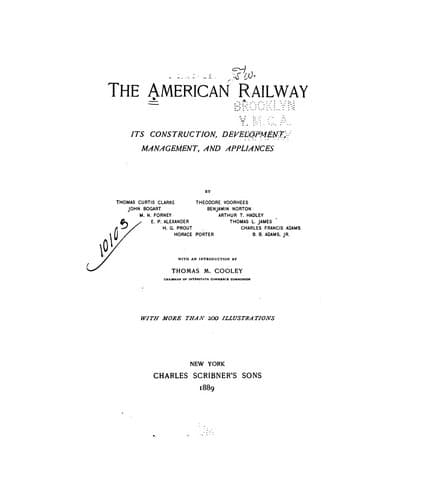
The American Railway: Its Construction, Development, Management, and AppliancesClarke, Thomas Curtis
History
The American Railway: Its Construction, Development, Management, and Appliances
Clarke, Thomas Curtis
Railroads -- United States
progress toward the happy solution of many vexed social questions.
FOOTNOTES:
[14] See "How to Feed a Railway," page 302.
[15] See "The Freight-car Service," page 275.
[16] Of course, this "stringing" of an extra train is not always
done in actual operation. Practice and experience will give as
wonderful expertness to a train-despatcher in handling trains "in
his head" as to a mathematician in solving problems, and often all
trains on a road will be handled entirely "by order," or as extras.
But the example given illustrates the principle upon which expert
practice is based.
[17] See "Safety in Railroad Travel," page 204.
[18] See "The Freight-car Service," page 288.
[19] An idea may be gained of the extent and minuteness of the
classification, and of the constant changes and adjustments,
both of rates and classifications, perpetually going on from the
following partial list of subjects submitted to a recent meeting
of the Rate Committee of the Southern Railway and Steamship
Association.
RATES.--Watermelon rates; canned goods, Richmond to Atlanta; rates
on cement from Eastern cities to Association territory; rates
on sulphuric acid from Atlanta; rates from Atlanta, etc., to
California and Transcontinental terminals; special iron rates from
Cincinnati, etc., to Carolina points; rates on earthenware, East
Liverpool to S. E. territory; rates on cotton bags to Memphis from
Atlanta; rates on fertilizers to Mobile, Ala.; beer rates; rates
on special iron articles from Chattanooga; rates from the West to
Camden, S. C.; rates from Evansville and Cairo, on business from
points between Cairo, Evansville, and Chicago.
CLASSIFICATION.--Classification of paper twine; beer packages,
empty returned; old machinery returned for repairs; steel car
springs; cotton softener; iron safes or vaults weighing over 12,000
lbs.; toys, etc.; portable powder magazines; coffee extract; empty
lard tierces returned; bolts and nuts in barrels; box and barrel
material; glass oil bottles in tin jackets; cast-iron radiators;
malleable iron castings; dried beef; sausage; straw paper; burlaps;
tobacco stems; hinges; straw braids; lawn hose reels; excelsior;
car-load rates.
SUBJECTS NOT ON THE REGULAR LIST.--Demurrage rules; adjustment of
rates as per instructions from the Executive Board; rates from
Cincinnati to Columbus, Eufaula, Opelika, etc.; classification of
iron tanks; classification of whiting; rates to Eufaula, Ala., from
East; rates to Milledgeville, Ga.; classification of cast-iron cane
mills; classification of locomotives and tenders.
SAFETY IN RAILROAD TRAVEL
BY H. G. PROUT.
Public-domain text, read in full here on John Shaqi.
Reviews
Reviews
No reviews yet
Be the first to share your thoughts on this work.
Elsewhere in the archive
Join the Discussion
Join the discussion
Sign in to leave a comment or review.
Sign InorCreate an account