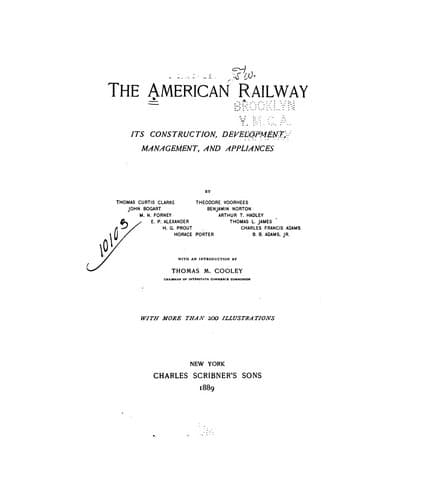
The American Railway: Its Construction, Development, Management, and AppliancesClarke, Thomas Curtis
History
The American Railway: Its Construction, Development, Management, and Appliances
Clarke, Thomas Curtis
Railroads -- United States
The Possibilities of Destruction in the Great Speed of
a Locomotive--The Energy of Four Hundred Tons Moving at
Seventy-five Miles an Hour--A Look ahead from a Locomotive at
Night--Passengers Killed and Injured in One Year--Good Discipline
the Great Source of Safety--The Part Played by Mechanical
Appliances--Hand-brakes on Old Cars--How the Air brake Works--The
Electric Brake--Improvements yet to be Made--Engine Driver
Brakes--Two Classes of Signals: those which Protect Points
of Danger, and those which Keep an Interval between Trains
on the Same Track--The Semaphore--Interlocking Signals and
Switches--Electric Annunciators to Indicate the Movements--The
Block Signal System--Protection for Crossings--Gates and
Gongs--How Derailment is Guarded Against--Safety Bolts--Automatic
Couplers--The Vestibule as a Safety Appliance--Car Heating and
Lighting.
In 1829, when Ericsson's little locomotive "Novelty," weighing two
and a half tons, ran a short distance at the rate of thirty miles
an hour, a writer of the time said that "it was the most wonderful
exhibition of human daring and human skill that the world had
ever seen." To-day trains weighing four hundred tons thunder by
at seventy-five miles an hour, and we hardly note their passage.
We take their safety as a matter of course, and seldom think of
the tremendous possibilities of destruction stored up in them. But
seventy-five miles an hour is one hundred and ten feet a second,
and the energy of four hundred tons moving at that rate is nearly
twice as great as that of a 2,000-pound shot fired from a 100-ton
Armstrong gun. This is the extreme of weight and speed now reached
in passenger service, and, indeed, is very rarely attained, and
then but for short distances; but sixty miles is a common speed,
and a rate of forty or fifty miles is attained daily on almost
every railroad in the country. We cannot tell from the time-tables
how fast we travel. The schedule times do not indicate the delays
that must be made up by spurts between stations. The traveller
who is curious to know just how fast he is going, and likes the
stimulus of thinking that he is in a little danger, may find
amusement in taking the time between mile-posts; and when these
are not to be seen, he can often get the speed very accurately by
counting the rails passed in a given time. This may be done by
listening attentively at an open window or door. The regular clicks
of the wheels over the rail-joints can usually soon be singled out
from the other noises, and counted. The number of rail-lengths
passed in twenty seconds is almost exactly the number of miles run
in an hour.
[Illustration: Danger Ahead!]
Public-domain text, read in full here on John Shaqi.
Reviews
Reviews
No reviews yet
Be the first to share your thoughts on this work.
Elsewhere in the archive
Join the Discussion
Join the discussion
Sign in to leave a comment or review.
Sign InorCreate an account