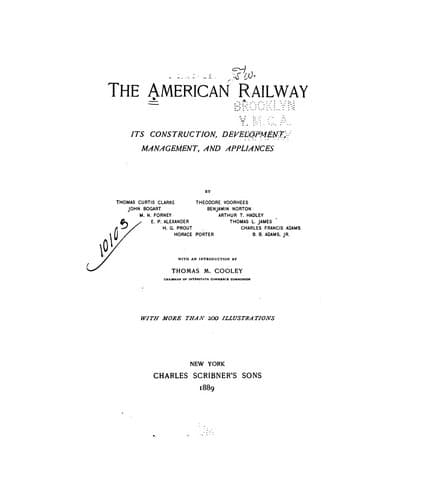
The American Railway: Its Construction, Development, Management, and AppliancesClarke, Thomas Curtis
History
The American Railway: Its Construction, Development, Management, and Appliances
Clarke, Thomas Curtis
Railroads -- United States
Although the air-brake can almost talk, it is still not perfect.
There are several fortunes to be made yet in improving it. For
instance, it is desirable, in descending long and steep grades,
that the brake-pressure should be just sufficient to control the
speed of the train, and should be steadily applied; otherwise
the descent will be by a succession of jerks which may become
dangerous. With the automatic the brakes must be occasionally
released to recharge the reservoirs, or when the speed of the train
is too much reduced; and it is difficult to keep a uniform speed.
So far, the means devised to overcome this difficulty and keep a
constant and light pressure on the wheels have been thought too
costly or complicated for general use. With hand-brakes long trains
are controlled by the brakes of but a few of the cars in any one
train. It follows that in the descent of grades the braked wheels
must often run for miles with the pressure as great as it can be
without sliding the wheels. The rim of the wheel is rapidly heated
by the friction of the brake-shoe, and the unequal expansion of
the heated and the unheated parts of the wheel causes a fracture.
This is why so many broken car-wheels are found at the foot of
grades--of all places the worst for such an accident to happen.
With "straight air," that is, with the pressure from the main
reservoir, or the air-pump, going directly to the brake-cylinder,
the engineer can apply the brakes to all the wheels of his train
simultaneously, and with great delicacy of graduation; and by
turning a three-way cock which is placed in the piping of each
car, the air can be used "straight." This is regularly done on
some mountain-roads. At summits the trains are stopped and the
brakes are changed from "automatic" to "straight." This practice is
dangerous, however, and is not approved by the best brake-experts,
for if a hose bursts, or through some other accident the air in
the train-pipe escapes, the brakes are useless. The automatic
arrangement by which a reduction of air-pressure in the train-pipe
applies the brakes, as previously explained, is much preferred,
although no entirely satisfactory means has yet been devised for
automatically regulating the air-pressure in the brake-cylinder.
Public-domain text, read in full here on John Shaqi.
Reviews
Reviews
No reviews yet
Be the first to share your thoughts on this work.
Elsewhere in the archive
Join the Discussion
Join the discussion
Sign in to leave a comment or review.
Sign InorCreate an account