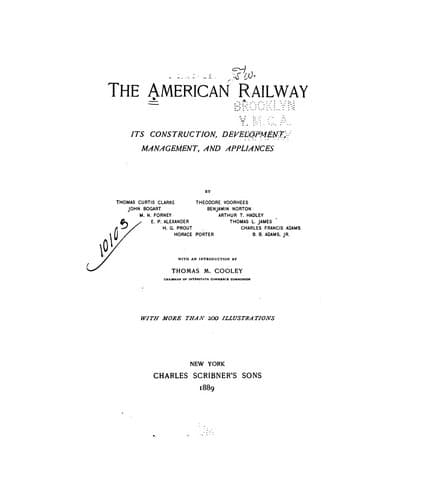
The American Railway: Its Construction, Development, Management, and AppliancesClarke, Thomas Curtis
History
The American Railway: Its Construction, Development, Management, and Appliances
Clarke, Thomas Curtis
Railroads -- United States
There is not space here to enter into the history of the air-brake.
It was first practically applied to passenger trains in 1868.
The first great epoch in its subsequent development was the
invention, by Mr. George Westinghouse, Jr., of the triple valve.
The introduction of the triple valve at once reduced the time of
full application of the brake for a ten-car train from twenty-five
seconds to about eight seconds. This means, at forty miles an hour,
a reduction by more than one thousand feet in the distance in which
a train can be stopped. The next great epoch in the history of the
air-brake was made by the celebrated Burlington brake-trials of
1886 and 1887. These trials were undertaken by a committee of the
Master Car-builders' Association, to determine whether or not there
was any power-brake fit for freight service. For general freight
service the brake must be capable of arresting a very long train,
with cars loosely coupled, running at a fair average passenger
speed, without producing objectionable shocks in the rear of the
train. The two series of trials were carried out in July, 1886,
and May, 1887. The competing brake-companies brought to the trials
trains of fifty cars each, equipped with their devices. Skilled
mechanical engineers from various railroad and private companies
assisted both years. These trials were most exhaustive, and have
contributed more to the art of braking than any that preceded or
have followed them. The first year's trials developed the fact that
the air-brakes could not be applied on the rear of a fifty-car
train in less than eighteen seconds, whereas the head of a train
moving twenty miles an hour could be completely stopped in fifteen
seconds. The result was that disastrous collisions between the
cars of any one train were produced in the act of stopping. Men in
the rear cars were thrown down and injured, and much damage was
done to the cars. At the end of nineteen days the brake-companies
went home to work another year over the new problem. In 1887 they
reappeared on the same ground, and in eighteen days proved that
no simple air-brakes, as then operated, could prevent disastrous
shocks in a long train; but it was shown that by bringing in
electricity to actuate the air-valves, the application of the
brakes could be made practically simultaneous throughout the train.
Mr. Westinghouse, however, during the summer following, made such
modifications in the triple valve and in the train-pipe that he
succeeded in applying the brakes throughout a fifty-car train in
two seconds. That settled the matter. He at once equipped a train
of fifty cars, and in October and November, 1887, that train made
a journey of about three thousand miles, making exhibition stops
at various cities. The journey was a splendid and conclusive
demonstration that the air-brake is now a thoroughly efficient
and reliable contrivance for freight as well as for passenger
service. The result has been a very rapid application of the new
Public-domain text, read in full here on John Shaqi.
Reviews
Reviews
No reviews yet
Be the first to share your thoughts on this work.
Elsewhere in the archive
Join the Discussion
Join the discussion
Sign in to leave a comment or review.
Sign InorCreate an account