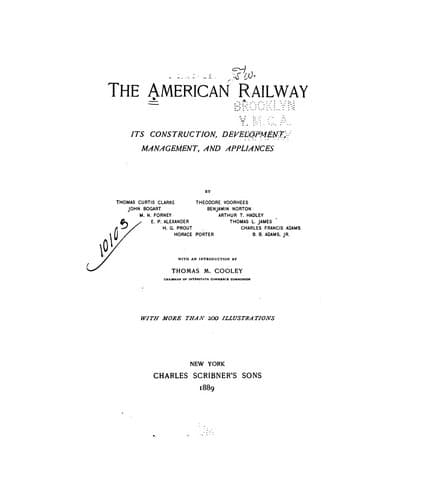
The American Railway: Its Construction, Development, Management, and AppliancesClarke, Thomas Curtis
History
The American Railway: Its Construction, Development, Management, and Appliances
Clarke, Thomas Curtis
Railroads -- United States
quick-acting brake to freight cars. The performance of this train
was to railroad men most impressive. A freight train of fifty cars
is about one-third of a mile long. To see such a train, running
forty miles an hour, smoothly stopped in one-third of its own
length, without shock or fuss, was an object-lesson that no one
could fail to understand or to remember. Some of the stops made by
this train will give a fair notion of the relative power of hand-
and air-brakes for quick stops. The following figures are averages
of stops made in six different cities. They give the distances run
in feet from the instant of applying the brakes till the train was
brought to a stand-still:
Feet.
Hand-brakes, 50 cars, 20 miles an hour 794
Air-brakes, 50 cars, 20 miles an hour 166
Air-brakes, 50 cars, 40 miles an hour 581
Air-brakes, 20 cars, 20 miles an hour 99
With twenty cars at twenty miles an hour even shorter stops were
made than those recorded above. In the Burlington trials the
hand-brake stops, with fifty-car trains at forty miles an hour,
were made in from two thousand five hundred to three thousand feet.
[Illustration: Dwarf Semaphores and Split Switch.]
The air-brake is somewhat complicated, but the complicated
mechanism is strong, has little movement, and is securely protected
from dirt and the elements. It is therefore little liable to
derangement. It is, however, becoming better understood that
brake-gear must be good, and employees carefully instructed in
the care and use of the air-brake to get its best results; and in
recent years two or three elaborate instruction-cars have been
fitted up for the education of the enginemen and trainmen.
Space does not permit more than an allusion to driver-brakes,
which are operated by steam and by air. The forms in constant use
are made by the Eames, the American, the Westinghouse, and the
Beals companies. Nor can much be said here of the water-brake,
used to some extent on locomotives working heavy grades. It
consists of a simple arrangement of admitting a little hot water,
instead of steam, to the cylinders. The engine is reversed and the
cylinder-cocks are opened to the air. The cylinders then act as
air-pumps, and the retarding effect is due to the back pressure.
The use of the water is to prevent overheating of the parts.
[Illustration: Semaphore Signal with Indicators.
(One arm governs several tracks. The number of the track which is
clear is shown on the indicator disk.)]
Public-domain text, read in full here on John Shaqi.
Reviews
Reviews
No reviews yet
Be the first to share your thoughts on this work.
Elsewhere in the archive
Join the Discussion
Join the discussion
Sign in to leave a comment or review.
Sign InorCreate an account