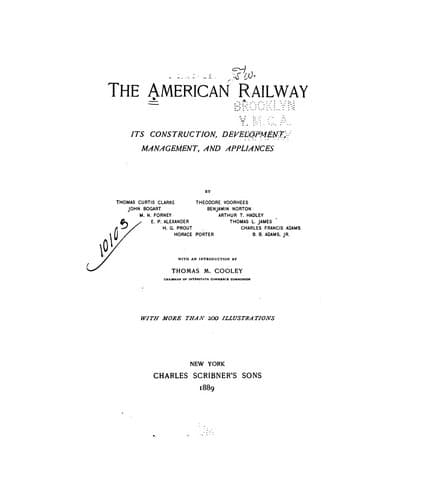
The American Railway: Its Construction, Development, Management, and AppliancesClarke, Thomas Curtis
History
The American Railway: Its Construction, Development, Management, and Appliances
Clarke, Thomas Curtis
Railroads -- United States
In the front of the apparatus is seen a rank
of small handles, which can be turned from side to side with as
much ease as the keys of a piano can be depressed. Turning one of
these handles admits compressed air to the end of a pipe containing
liquid. Instantly the pressure is transmitted 500 or 1,000 feet
to the valve at the switch to be moved. The small levers are
interlocked perfectly, and in that particular perform the duties of
the ordinary machine. A model of the tracks controlled is placed
before the operator, showing the switches and signals, and when
a movement is made on the ground it is at once repeated back by
electricity and duplicated on the model. This beautiful system is
due to the same genius that gave us the perfected air-brake and the
triple valve, and is the greatest improvement that has been made in
interlocking in the last dozen years.
[Illustration: Interlocking Apparatus for Operating Switches and
Signals by Compressed Air, Pittsburg Yards, Pennsylvania Railroad.
(A model of the track is shown above the levers, on which the
movements of the switches and signals are electrically indicated
after they are completed.)]
[Illustration: Torpedo Placer.
(The torpedo is carried forward by the plunger and exploded by the
depression of the hammer shown near the rail.)]
If the reader has grasped the full significance of interlocking, he
understands that it makes it impossible to give a signal that would
lead to a collision or to a derailment at a misplaced switch. The
worst that a stupid, or drunken, or malicious signalman could do
would be to delay traffic, if the signals were obeyed. Here comes
in the failing case. The brake-power may be insufficient to stop a
train after a danger signal is given. That is a rare occurrence,
but may happen. The engineer may not see the danger signal because
of fog, or he may carelessly run past it. Provision against a
failure to see and to obey a signal may be made by placing on the
track a torpedo, which will explode with a loud report when struck
by a wheel. The use of hand-torpedoes in fogs, and for emergencies
in places unprovided with fixed signals, is very common. These are
little disks filled with a detonating powder, and provided with
tin straps that are bent down to clasp over the top of the rail.
A simple and very efficient torpedo machine, which has been used
for some years on the Manhattan Elevated and elsewhere, is here
shown. This machine has a magazine holding five torpedoes. It is
connected to a signal-lever in such a way that, when the signal is
put to danger, one torpedo is placed in a position to be exploded
by the first passing wheel. When the signal returns to the clear
position the torpedo, if unexploded, is withdrawn to the magazine.
If the torpedo is exploded another one takes its place at the next
movement of the signal-lever. One of these machines on the Elevated
Road moves about five thousand times every day. In such a case a
Public-domain text, read in full here on John Shaqi.
Reviews
Reviews
No reviews yet
Be the first to share your thoughts on this work.
Elsewhere in the archive
Join the Discussion
Join the discussion
Sign in to leave a comment or review.
Sign InorCreate an account