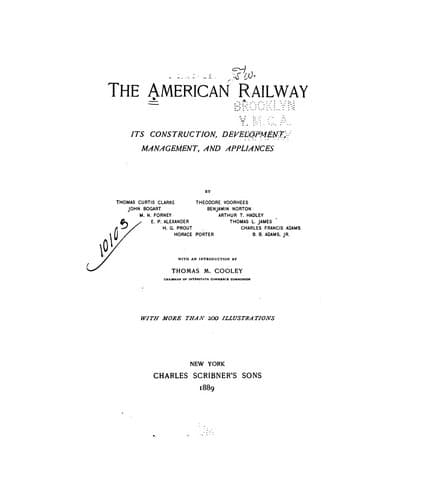
The American Railway: Its Construction, Development, Management, and AppliancesClarke, Thomas Curtis
History
The American Railway: Its Construction, Development, Management, and Appliances
Clarke, Thomas Curtis
Railroads -- United States
torpedo would soon be worn out if it was not exploded or frequently
changed. When this apparatus is in operation, an unmistakable
alarm is at once given to the engineer and to others if a danger
signal is passed. On the Manhattan Elevated lines an engineman who
overruns a danger signal and can show no good reason for it is
suspended for the first offence, and discharged for the second. The
torpedo makes it impossible for him to escape detection.
* * * * *
[Illustration: Old Signal Tower on the Philadelphia & Reading, at
Phœnixville.]
The second great class of signals comprises those which are
intended to keep fixed intervals of space between trains running
on the same track. These are block signals. The block system is
used on a few of the railroads of the United States which have
the heaviest and fastest traffic. Much the most common practice
in this country, however, is to run trains by time intervals, and
under the constant control of the train despatcher. In England the
block system is almost universal. About ninety per cent. of all the
passenger lines of that country are worked under the absolute block
system.
When the block system is not used, it is quite common to protect
particularly dangerous points, such as curves and deep cuts, by
stationing watchmen there with flags or with some form of fixed
signal. The watchman can notify an approaching engine-runner that
a preceding train has or has not passed beyond his own range of
vision; or can notify him that it has been gone a certain time.
Travellers by the Philadelphia & Reading must have noticed the
queer structures, with revolving vanes on top, looking like a
feeble sort of windmill, which appear in positions to command a
view of cuts, curves, etc. These are examples of the devices for
local protection. The non-automatic block signal develops naturally
from the protection of scattered points. Instead of placing
watchmen at points of especial danger, they are placed at regular
intervals of one mile, two miles, or five miles. Instead of the
watchman looking to see that a train has disappeared from his field
of vision before he lets another train pass, he uses the eyes of
the next watchman ahead, who telegraphs back that the train has
passed his station. Suppose A, B, and C to be three block-signal
stations placed at intervals of two miles. When a train passes A,
the operator at that point at once puts a signal to danger behind
it. This signal stands at danger until the train passes B, and
the operator puts his signal to danger, and telegraphs back to A
to announce that train No. 1 has passed out of the block A B, and
is protected by the signal at B. Then, and not until then, the
operator clears the signal at A and allows train No. 2 to enter
the block. Meanwhile train No. 1 is proceeding through the block
B C, its rear protected at B; and the same sequence of events
happens when it arrives at C as happened at B. This is the simplest
Public-domain text, read in full here on John Shaqi.
Reviews
Reviews
No reviews yet
Be the first to share your thoughts on this work.
Elsewhere in the archive
Join the Discussion
Join the discussion
Sign in to leave a comment or review.
Sign InorCreate an account