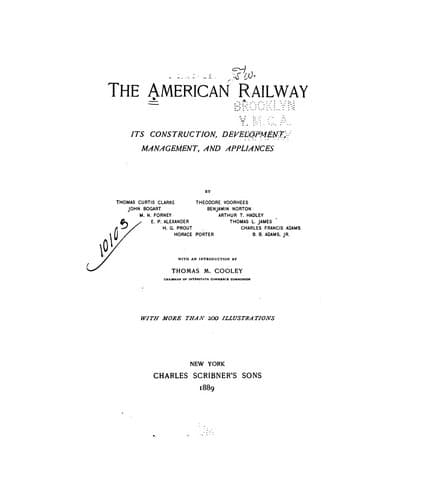
The American Railway: Its Construction, Development, Management, and AppliancesClarke, Thomas Curtis
History
The American Railway: Its Construction, Development, Management, and Appliances
Clarke, Thomas Curtis
Railroads -- United States
form of block signalling. In the more elaborate form there are at
each block-station three signals--the distant, the home, and the
starting. The signals are often electrically interlocked, from
one station to another, in such a way that it is mechanically
impossible for the operator at A to give a signal for a train to
pass that station until the signal at B has been put to danger
behind the preceding train.
A B C
-----------------------------
It is seen that no two trains can be in the same block and on the
same track at the same time. If all run at a uniform speed, they
will be kept just the length of a block apart. If No. 2 is faster
than No. 1, it will arrive at B before No. 1 gets to C, but will
have to wait there. The block system, therefore, while it gives
security, does not always facilitate traffic. The longer the blocks
the greater will be the delay to trains; but the shorter the
blocks, the greater the cost of establishment, maintenance, and
operation.
Various systems have been contrived to have block signals displayed
automatically by the passage of trains. This, if it can be done
reliably, will do away with the wages of part of the operators, and
will also eliminate the dangers arising from human carelessness.
But there are very great objections to relying solely upon the
automatic action of signals, and automatic block signals are little
used except as auxiliary to a system employing operators also.
So used, they are of decided advantage, as they make sure that a
danger signal is set behind every train in spite of the operator,
and that it cannot be again set to the all-clear position till the
train has passed out of the block. All this is accomplished by
electricity.
Brakes, interlocking, and the apparatus of signalling have been
considered at length because they are very much the most important
of all the appliances which go to increase the safety of operating
railroads. They act chiefly to prevent collisions, but often
prevent or mitigate accidents from derailments and other causes.
Of all train-accidents happening in the last sixteen years, over
one-third have been from collisions, and more than one-half from
derailments.
* * * * *
[Illustration: Crossing Gates worked by Mechanical Connection from
the Cabin.]
Public-domain text, read in full here on John Shaqi.
Reviews
Reviews
No reviews yet
Be the first to share your thoughts on this work.
Elsewhere in the archive
Join the Discussion
Join the discussion
Sign in to leave a comment or review.
Sign InorCreate an account