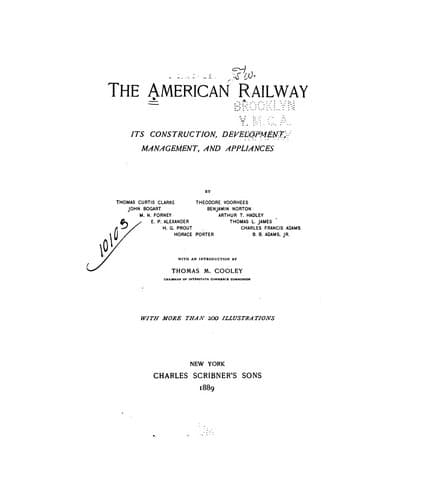
The American Railway: Its Construction, Development, Management, and AppliancesClarke, Thomas Curtis
History
The American Railway: Its Construction, Development, Management, and Appliances
Clarke, Thomas Curtis
Railroads -- United States
ties are the first safeguard against such accidents. Metal plates
under the rails are useful also; but one of the most efficient
means of preventing displacement of the rails is the interlocking
bolt shown above. These bolts cross in the timber, and slots cut
in the two bolts engage with each other in such a way that when
the nuts are screwed down on the rail-flange it is impossible to
pull the bolts out. They can only be moved by tearing through the
wood contained in the angle between them. This bolt is much used
on bridges and trestles, where it is of vital importance that the
rails should be held in place and no part of the floor broken.
[Illustration: New South Norwalk Drawbridge. Rails held by safety
bolts.]
In 1853 an express train went through an open draw at South
Norwalk, Conn., and forty-six lives were lost. This, one of the
most serious railroad accidents that ever happened, is still
remembered as an historical calamity. The bridge which stands on
the same site is shown opposite. In May, 1888, a west-bound express
train, consisting of an engine and seven cars, was derailed just as
it was entering the draw-span. The train ran three hundred feet on
the sleepers before it was stopped. Then it was found that all of
the driving-wheels of the engine had regained the rails, but all
the other wheels were off, except those of two sleeping-cars in the
rear. This was a remarkable escape from a bad accident, and much
of the credit of it has been given to the interlocking bolts with
which the rails were fastened. They are supposed to have prevented
the rails being crowded aside, and thus to have made possible the
rerailing of the engine. Besides, they helped the oak guard-timbers
to hold the ties in place. The destruction of a bridge in an
accident frequently begins by the ties bunching in front of the
wheels and allowing the wheels to drop through and strike the
floor-beams below. For this reason guard-timbers, notched down over
the ties, should always be used.
[Illustration: Engines Wrecked during the Great Wabash Strike.]
Public-domain text, read in full here on John Shaqi.
Reviews
Reviews
No reviews yet
Be the first to share your thoughts on this work.
Elsewhere in the archive
Join the Discussion
Join the discussion
Sign in to leave a comment or review.
Sign InorCreate an account