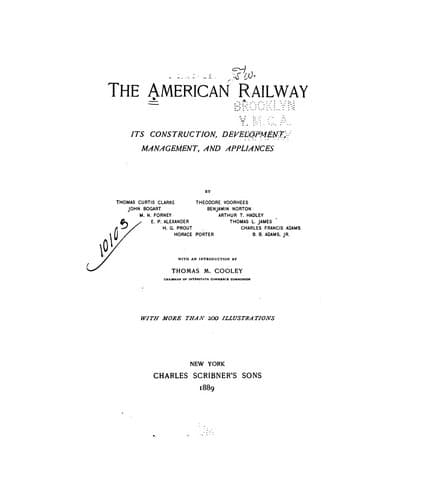
The American Railway: Its Construction, Development, Management, and AppliancesClarke, Thomas Curtis
History
The American Railway: Its Construction, Development, Management, and Appliances
Clarke, Thomas Curtis
Railroads -- United States
The traveller will have noticed, on all bridges of various roads,
two rails placed inside the track-rails, and curved to meet in
a point at either end of the bridge. These are known as inside
guard-rails, and their function is to keep derailed trucks in line
till the train can be stopped. Besides the bunching of the ties,
there is danger in a bridge derailment that a truck may swing
around and strike one of the trusses. Then the bridge is very
likely to be wrecked. A further provision for the protection of
bridges is the rerailing frog invented by the late Charles Latimer,
whose name is dear to railroad men all over America. This consists
of a pair of castings combined with inside guard-rails, designed
to raise the derailed wheels and guide them on to the rails. There
is no doubt that it has prevented several wrecks, although it has
never been widely used. The subject of bridges should not be left
without a word of explanation of the stout timber-posts often seen
at either end placed in line with the trusses. These are designed
to stop any derailed vehicle which might otherwise strike against
and destroy a truss.
* * * * *
There is one track-fixture that has no duty or value except as
it promotes safety. It helps only one humble class of railroad
employees. That device is the foot-guard. At all places where two
rails cross or approach each other, as at frogs and guard-rails,
dangerous boot-jacks are formed by the rail-heads. The overhang of
the heads of the rail makes it easy for one to so fasten his foot
in one of those boot-jacks that it is hard to get it out. If a man
finds himself in this position in front of an approaching train, he
sometimes has the alternative of standing up to be struck by the
engine or lying down and having his foot cut off. Fortunately this
class of accidents is comparatively rare; probably not more than
two or three per cent. of all deaths and injuries to passengers
and employees is caused in this way. Nevertheless, the means of
guarding against accidents of this class is so cheap that it should
be more generally adopted than it is. It consists simply in partly
filling the space between the rail-heads by putting in wooden
blocks or strips of metal, or even packing with cinders, gravel, or
any sort of ballast. Various wooden and metal foot-guards have been
patented. They are all too simple to require description.
* * * * *
[Illustration: Link-and-pin Coupler.]
Public-domain text, read in full here on John Shaqi.
Reviews
Reviews
No reviews yet
Be the first to share your thoughts on this work.
Elsewhere in the archive
Join the Discussion
Join the discussion
Sign in to leave a comment or review.
Sign InorCreate an account